Need help? 24/7

10 Step Guide to cGMP Certification
Getting a GMP certification is a lengthy process and goes through many steps. This 10 step guide will help everyone to follow those steps easily. In the pharmaceutical industry, it is mandatory to get certified by regulatory agencies. GMP certification ensures the quality of pharmaceutical products. Compliance with regulatory requirements ensures the efficacy and safety of pharmaceutical products.
This article will provide the manufacturers a 10-step guide to getting GMP certification and help them to know the process of getting certified and the benefits of complying with regulatory standards.
What is cGMP?
cGMP or current good manufacturing practices are the latest regulatory recommendations provided by different regulatory agencies like the US-FDA, EMA, ICH and WHO. These regulatory standards are about the whole manufacturing process from raw material testing to manufacturing to ensure product identity, quality and purity. The "current" in cGMP indicates that companies must follow up-to-date techniques and systems to comply with the regulatory requirements
Why cGMP Certification is Important
cGMP certification in pharmaceuticals is important due to following reasons.
- Regulatory Requirement: cGMP compliance is a regulatory requirement to get market authorization in many countries like the United States, the European Union, Australia and Japan. Without market authorization, it is not possible to sell pharmaceutical products in these countries.
- Product Quality and Safety: cGMP compliance ensures that the products manufactured in the facility are effective and safe for the patients.
- Market Access: A GMP-compliant manufacturer can trade globally, especially in regulated markets like the United States and the European Union.
- Reputation and Trust: A cGMP-certified manufacturing facility builds confidence among consumers.
- Reduces Recalls: cGMP certification minimizes errors, contamination and non-compliance issues in the market therefore reducing product recall and legal issues.
Step-by-Step Guide to Achieving cGMP Certification
Step1: Understand Regulatory Requirements
Before applying for cGMP certification, it is required to understand specific cGMP requirements applicable to the product and the country. Some common guidelines for different regions include:
- 21 CFR Part 210 & 211 – US FDA (United States)
- EU GMP Guidelines – European Union
- WHO GMP – Internationally Accepted
- ICH Q7, Q8, Q9 and Q10 – International standards of APIs and Quality System
Step 2: Conduct a Gap Analysis in all Departments
A gap analysis in the pharmaceutical industry helps to find the difference between current practices and regulatory requirements. It is a very common and widely used method to find compliance issues and areas for improvement in manufacturing facilities.
Following are some areas to evaluate during gap analysis.
Facility design, SOPs and documentation, Personnel training and records, Equipment qualifications, Process validation & Quality assurance systems, Record maintenance and traceability
The gaps found during the gap analysis must be documented and addressed by the CAPA management tool.
Step 3: Establish a Quality Management System
A perfect quality management system is the backbone of cGMP compliance in the pharmaceutical industry. It should include:
- Standard Operating Procedures (SOPs): Everything that is being done in the company must be written and that is written must be done. It is a documentation slogan in pharmaceuticals.
- Quality Manual: A quality manual contains all quality policies of the company.
- Good Documentation Practices: Good documentation practices must be followed in all departments and ALCOA principles must be applied for proper documentation and record maintenance.
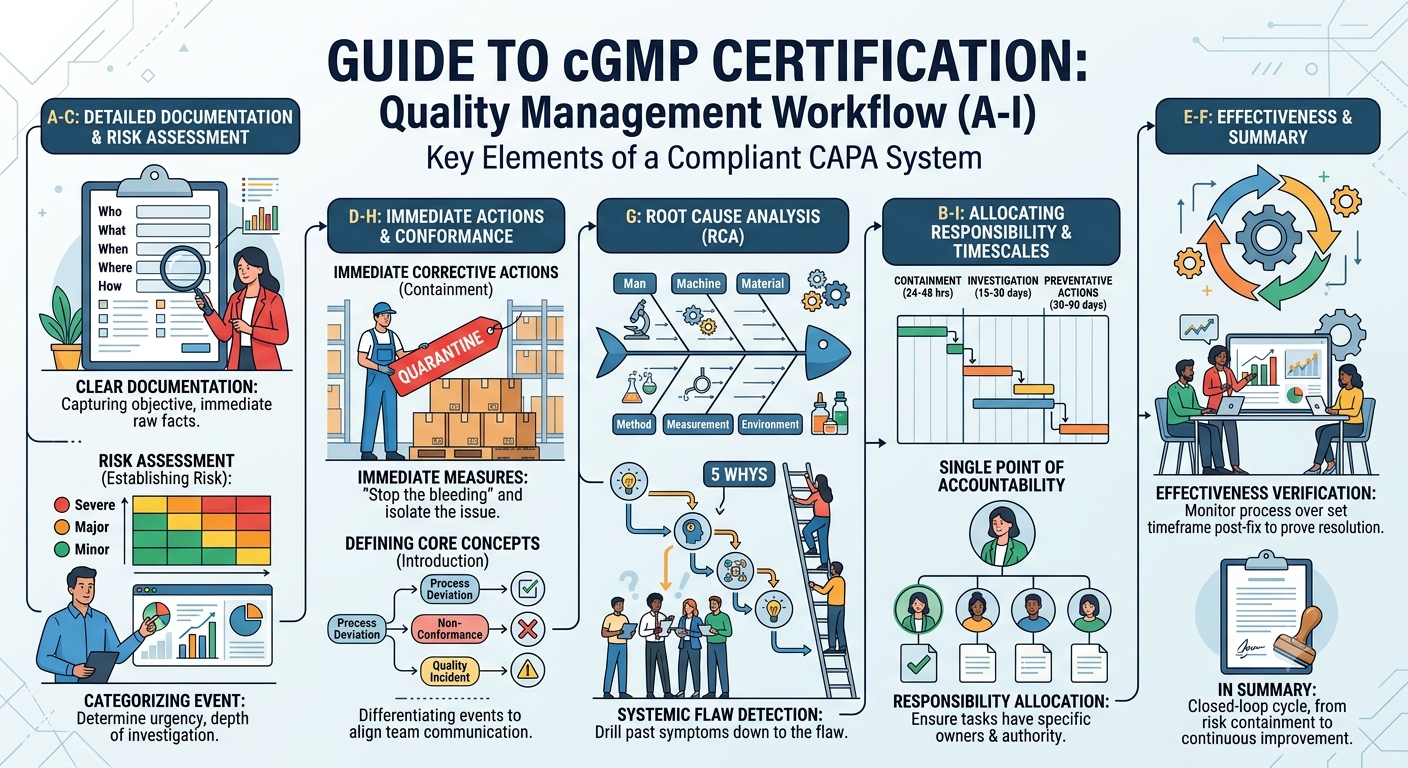
- Deviation and CAPA: All deviations and errors must be documented and must be addressed by proper corrective and preventive actions.
- Change Controls and Risk Management: All changes should be documented and a risk assessment must be done for all processes and systems that can have any risk regarding product quality.
Step 4: Personnel Training
Human error is the most common cause of GMP non-compliance in pharmaceuticals. Everyone should have proper training in their work. The essential training topics include: cGMP principles, SOPs of the respective area, Good documentation practices, Personal hygiene, proper gowning and contamination control, Handling deviations, Corrective and preventive actions
Training must be ongoing as per the training calendar and it should be documented. There should be a refresher course for all employees annually or whenever there is any regulatory update.
Step 5: Validate Processes and Equipment
Validation of all processes, equipment and systems is a cGMP requirement. Validation ensures consistent performance of a process, equipment, or system. The following qualifications should be done for each process, equipment and system wherever applicable.
- Design Qualification: Design qualification is done to ensure that the design of an equipment or system fits the user's requirements.
- Installation Qualification: Installation qualification ensures that the equipment is installed correctly.
- Operational Qualification: Operational qualification verifies that equipment operates as intended and no operational issue detected.
- Performance Qualification: Performance qualification ensures that equipment consistently performs under real working conditions.
Validation activity should also cover analytical methods, cleaning procedures, sterilization processes and computerized systems. In short, every process, system and equipment must be validated.
Step 6: Document Control and Record Maintenance
Documentation is the backbone and evidence of cGMP compliance. A proper system should be implemented for managing documents like batch manufacturing records, equipment log books, training records, calibration and maintenance records and audit & inspection documents.
ALCOA principles for data integrity must be followed during the maintenance of documents. Document must be Attributable, Legible, Contemporaneous, Original, and Accurate. It means that data should not be changed and must remain in its original form.
Step 7: Perform Internal Audits
Internal audits or self-inspections help to get ready for any regulatory inspection. Many issues overlooked during the perpetration of audits are found during self-inspections. Self-inspections must be done by the staff of the other departments. Personnel carrying out the self-inspection should have sufficient experience and knowledge of the department to be audited. The following things must be considered during internal audits:- Facility inspection, Documentation review, Employee training and interviews, Quality control checks, Instrument calibrations, Deviation reports, Change controls & CAPA management.
Step 8: Apply for Certification
If you are confident that your facility complies with the regulatory requirements then contact the certification agency you are preparing for to schedule an official inspection. Following are some certifying authorities.
- USFDA (for the companies that want to market their products in the United States)
- EU GMP (for companies that want to market their products in the European Union)
- ISO (for international recognition)
- WHO (for international recognition)
- Local health authorities in your country The inspection includes the physical inspection of the facility, interview with staff and review of test records and validation documents.
Step 9: Address Inspection Findings (if any)
Initial inspection comes with observations or non-compliances which should be addressed within the time frame given by the regulatory authority. Deficiencies are reported in the form of FDA Form 483, WHO inspection reports or EU-GMP non-compliance letters.
You must analyze the root cause of the observations and submit a corrective and preventive action plan, implement planned corrective actions and provide a timeline to complete and follow up documentation.
Step 10: Maintain Compliance and Certification
cGMP is not a one-time task but it is a continuous process. Once your facility gets certified you must continue to conduct self-inspections, update training, revise SOPs periodically or as required, stay informed of regulatory updates and implement accordingly, and always prepare for surprise audits. It will be very difficult to maintain compliance unless you build a culture of quality within the company.
Final Tips for Successful cGMP Certification
- Hire an experienced GMP consultant for internal audits if required.
- Invest in quality staff and employee training.
- Use GMP-compliant software for documentation and data integrity.
- Compliance is not for once, focus on continuous improvement.
Getting cGMP certification is an achievement for any pharmaceutical company. It shows your commitment to product quality and patient safety. By following the above steps from understanding the GMP requirements to implementing a solid quality management system you can establish your organization as a trusted and quality-driven pharmaceutical manufacturer. If you have any issues in the implementation of GMP regulation, you can contact us.