Need help? 24/7

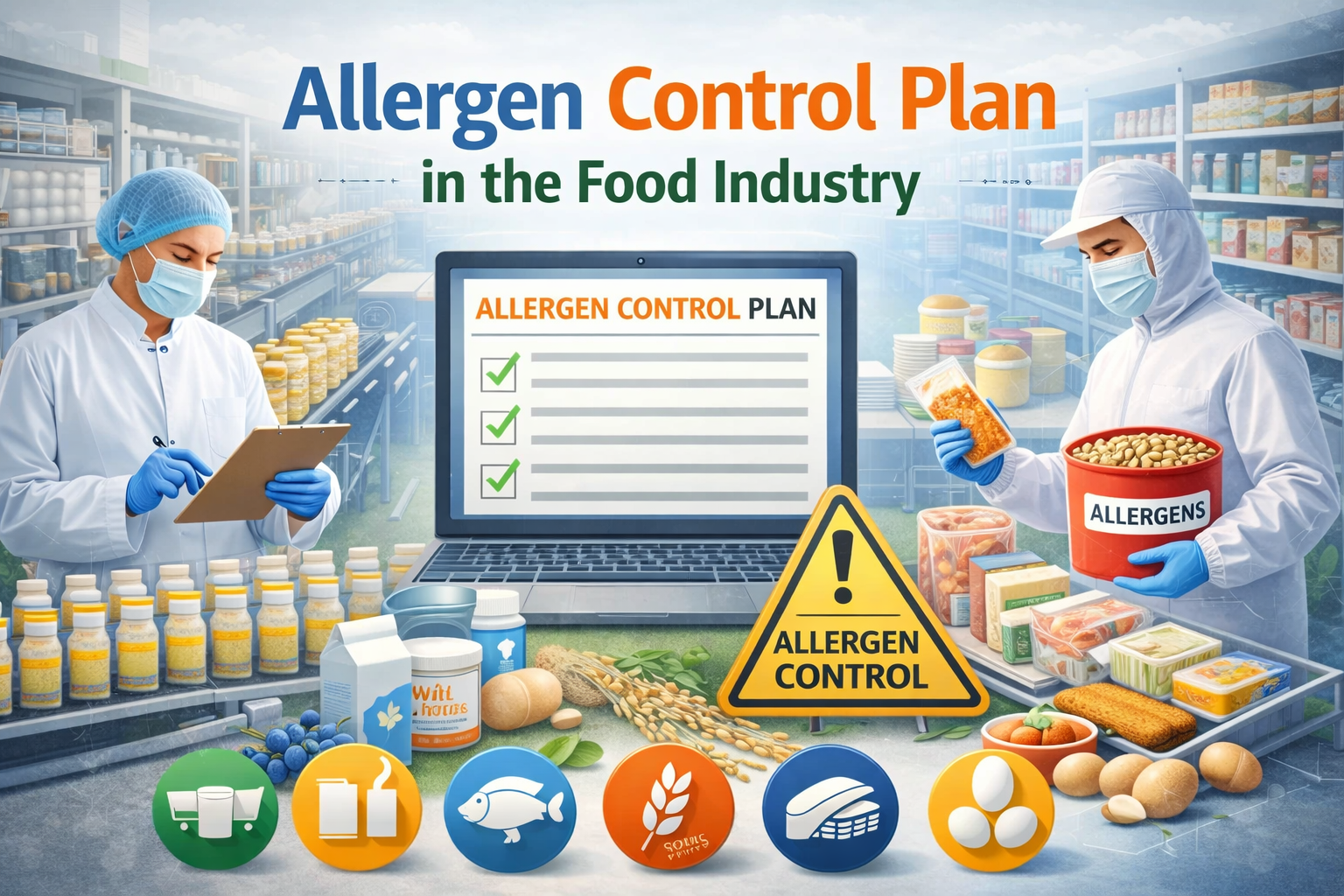
Allergen Control Plan in the Food Industry
Managing food allergens is a critical responsibility for food manufacturers, as undeclared allergens remain the leading cause of food recalls worldwide and pose life-threatening risks to sensitive consumers. An effective Allergen Control Plan (ACP) is a written, systematic strategy that identifies, tracks, and controls allergenic ingredients at every stage of the food supply chain—from raw material sourcing to final product labeling. This summary provides an in-depth analysis of the components and controls required for a robust ACP.
1. Introduction to Food Allergens
Food allergens are naturally occurring proteins in certain foods that can trigger abnormal immune responses in sensitive individuals. Unlike food intolerances, allergic reactions can be severe and even life-threatening, leading to conditions such as anaphylaxis.
An effective allergen control plan is critical for food manufacturers, as even trace amounts of allergens can pose serious health risks. Regulatory bodies worldwide mandate strict allergen management to ensure consumer safety and proper labeling.
2. Major Food Allergens
Globally recognized allergens (may vary by country) include: Milk, Eggs, Peanuts, Tree nuts (almonds, cashews, walnuts, etc.), Soy, Wheat (gluten), Fish, Shellfish, Sesame (increasingly regulated in many regions).
In India, FSSAI requires declaration of major allergens under labeling regulations.
3. Objectives of an Allergen Control Plan
The primary objectives include:
- Prevent cross-contact (cross-contamination) of allergens
- Ensure accurate product labeling
- Protect allergic consumers
- Comply with regulatory requirements
- Maintain brand integrity and avoid recalls
4. The Regulatory Landscape and "Major" Allergens
The foundation of any ACP is identifying which allergens require mandatory control. While regulations vary by region, most global standards are rooted in the Codex Alimentarius.
- The Big 9 (USA): As of 2023, the U.S. FDA recognizes nine major allergens: milk, eggs, fish, crustacean shellfish, tree nuts, peanuts, wheat, soybeans, and sesame.
- International Variations: The EU recognizes 14 allergens (including celery, mustard, and lupin), while Canada and Australia have additional requirements for sulfites and gluten.
- Preventive Controls (FSMA): Under the Food Safety Modernization Act (FSMA), facilities must implement "Allergen Preventive Controls" to prevent cross-contact and ensure accurate labeling.
5. Supplier Management and Raw Material Control
Control begins before ingredients even enter the facility. Because manufacturers rely on the accuracy of their suppliers’ information, a "garbage in, garbage out" risk exists.
- Approved Supplier Program: Every supplier must be vetted. This includes reviewing their own ACPs, audit reports, and requiring Certificates of Analysis (COAs) that verify allergen status.
- Ingredient Specifications: Manufacturers must maintain detailed specifications for every raw material. These specs must include a breakdown of sub-ingredients (e.g., "natural flavors" or "spice blends") to identify hidden allergens.
- Change Notification: Contracts should mandate that suppliers notify the manufacturer before changing a formulation that might introduce a new allergen.
6. Receiving and Storage Protocols
Once ingredients arrive, physical segregation is the primary defense against cross-contact.
- Inspection: Upon receipt, pallets must be inspected for leaks or broken bags. A single torn bag of wheat flour can contaminate an entire warehouse.
- Identification: Many facilities use a color-coding system (e.g., yellow for soy, blue for seafood) to tag pallets and containers. This visual cue helps staff quickly identify risks.
- Storage Hierarchy: The "Vertical Segregation" rule is vital: never store an allergen above a non-allergen or a different allergen. If a spill occurs, gravity ensures it only affects "like-into-like" products. Ideally, allergens are stored in dedicated rooms or zones.
7. Production Controls and Scheduling
The production floor is where the highest risk of cross-contact (the unintentional transfer of an allergen) occurs.
Strategic Scheduling: Production should follow a "Low-to-High" risk sequence. Allergen-free products are run at the start of the shift after a full sanitation, followed by products with increasing allergen complexity.
Traffic Control: Personnel, equipment (forklifts, bins), and air movement must be managed. Staff working on a line containing peanuts should not move to a peanut-free line without changing outer garments (smocks/gloves) and washing hands.
Dedicated Equipment: Where possible, facilities use dedicated lines for high-risk allergens. If shared lines are used, physical barriers or sufficient spacing must be maintained to prevent dust or splatters from migrating.
8. Sanitation and Validation
Standard cleaning is often insufficient for allergen removal; allergen-specific sanitation is required.
SSOPs (Sanitation Standard Operating Procedures): These must be written specifically for allergen changeovers, targeting "dead spots" like gaskets, valves, and conveyor underside.
Validation vs. Verification:
- Validation: Proving the cleaning method works (e.g., using ELISA testing to prove a specific SOP removes milk protein to undetectable levels).
- Verification: Routine checks (e.g., Lateral Flow Devices or protein swabs) performed after every cleaning to ensure the SOP was followed correctly.
Wet vs. Dry Cleaning: In dry environments (like flour mills), water can promote microbial growth. Here, manufacturers use vacuuming, "purging" (running salt/sugar through the system), or physical scraping.
9. Rework Management
Rework (product intended for reprocessing) is a common source of "stealth" allergens.
Like-into-Like Only: The golden rule is that rework containing an allergen can only be added to a batch of the same product or a product that already declares that specific allergen.
Traceability: Rework containers must be clearly labeled with the date, batch ID, and a full list of allergens. A digital or paper log must track every gram of rework from its creation to its final destination.
10. Labeling and Packaging Controls
The most frequent cause of allergen recalls is not cross-contact, but putting the wrong label on the product.
- Label Review: Artwork must be checked against the current recipe. If a formula changes (e.g., swapping sunflower oil for peanut oil), the labels must be updated immediately.
- Line Clearance: Before starting a packaging run, the line must be cleared of all previous labels and containers to prevent a "mixed-label" event.
- Automated Verification: Many modern facilities use barcode scanners or vision systems on the packaging line to ensure the label being applied matches the product being packed in real-time.
11. Training and Culture
An ACP is only as effective as the people executing it.
- Universal Training: Every employee, from the CEO to the maintenance crew and seasonal staff, must understand the "why" behind allergen controls.
- Maintenance Awareness: Maintenance staff must be trained to clean tools after working on an allergen line before moving to a non-allergen area.
- Food Safety Culture: A strong culture encourages employees to report spills or potential cross-contact immediately without fear of reprimand.
12. Food Safety Culture and Allergen Awareness
A strong food safety culture ensures:
Employee accountability, Management commitment, Continuous training, Organizations should promote allergen awareness through, Posters and visual aids, Regular training sessions, Performance monitoring
13. Challenges in Allergen Management
- Complex supply chains
- Hidden allergens
- Shared equipment
- Human errors
- Labeling mistakes
14. Best Practices for Allergen Control
- Develop a detailed allergen matrix
- Use color-coded systems
- Implement strict cleaning validation
- Automate labeling processes
- Conduct regular training and audits
15. Example of Allergen Control in a Beverage Industry
In a beverage plant (e.g., flavored drinks):
- Milk-based beverages processed separately
- Dedicated tanks or validated CIP cleaning
- Allergen-specific pipelines
- Label verification before packaging
16. Integration with Food Safety Systems
Allergen control is integrated with:
- HACCP (Hazard Analysis and Critical Control Points)
- GMP (Good Manufacturing Practices)
- ISO 22000 / BRCGS
- Allergens are considered a chemical hazard in HACCP plans.
17. Key Performance Indicators (KPIs)
Number of allergen-related incidents ,Cleaning validation success rate, Label accuracy rate, Audit compliance score
18. Quick Checklist (For Implementation)
✔ Allergen matrix available and updated
✔ Supplier declarations verified
✔ Segregation in storage and production
✔ Validated cleaning procedures
✔ Proper labeling and verification
✔ Employee training completed
✔ Internal audits conducted
✔ Recall system tested
Summary Table: Key Allergen Controls
An effective allergen control plan is essential for ensuring food safety, regulatory compliance, and consumer trust. It requires a holistic approach involving supplier management, process control, cleaning validation, labeling accuracy, and employee training.
Organizations that proactively manage allergens not only protect consumers but also strengthen their brand reputation and operational efficiency.
| Phase | Critical Control | Objective |
|---|---|---|
| Purchasing | Supplier Audit & COAs | Ensure no "hidden" allergens enter the facility. |
| Storage | Vertical Segregation | Prevent spills from contaminating lower pallets. |
| Production | Scheduling (Non-Allergen First) | Minimize the number of full-system cleanings. |
| Sanitation | Validation (ELISA Testing) | Scientifically prove the cleaning process is effective. |
| Packaging | Barcode Verification | Prevent the "Wrong Label/Wrong Box" error. |
| Rework | Like-into-Like Rule | Ensure allergens are accurately tracked in WIP. |
In conclusion, an Allergen Control Plan is a living document. It must be reviewed annually or whenever there is a change in equipment, suppliers, or product formulation. By integrating physical segregation, meticulous sanitation, and rigorous labeling checks, food manufacturers can effectively mitigate the risks of allergen cross-contact and protect their consumers.