Need help? 24/7

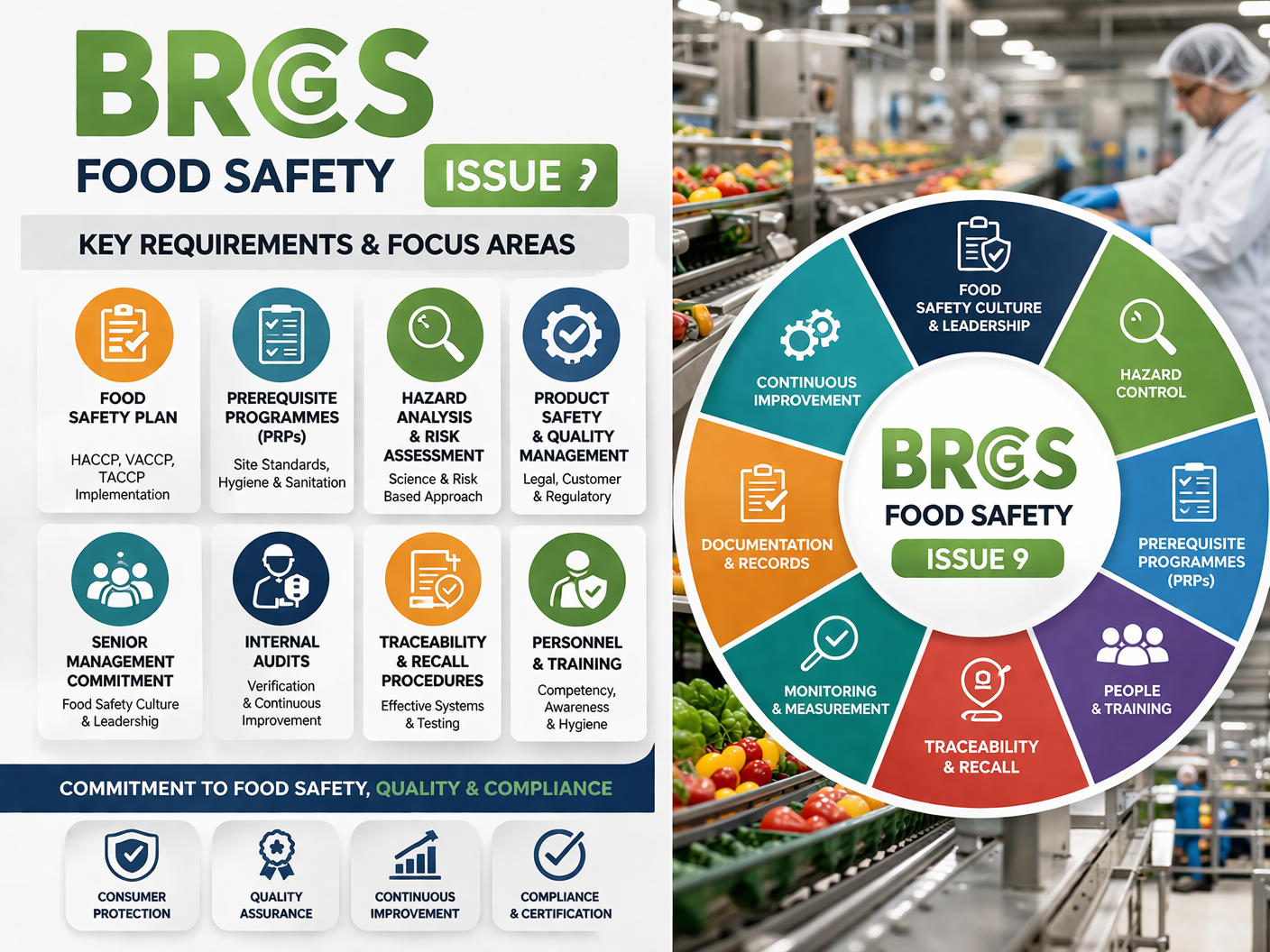
BRCGS Food Safety : Issue 9
Agenda
- Overview of BRCGS Issue 9, Key requirements, Critical risk areas, Implementation approach and Audit readiness.
Purpose
- Understand BRCGS Issue 9 requirements, Align operations with global standards, Strengthen food safety and compliance and Prepare for certification & audits.
What is BRCGS
- Global food safety certification standard
- Recognized by GFSI and major clients
- Applicable to food production and processing
- Focus on safety, legality, quality
Benefits of BRCGS Certification
- Global recognition, Improved operational control, Stronger risk management and Increased business opportunities.
BRCGS History
- BRCGS = Brand Reputation Compliance Global Standards
- BRC – British Retail Consortium
- UK retail association
- Developed food safety standards for suppliers
- Name Change (2018)
- BRC → BRCGS
- Transition from UK-focused to global standard
- Expanded across food, packaging, storage & distribution
Evolution to Issue 9
- 1996 – First BRC Food Standard developed
- 1998 – Issue 1 published
- 2017 – Issue 8 released
- 2018 – Rebranded to BRCGS
- 2022 – In August, Issue 9 published
- 2023 – Issue 9 implemented and Effective February 2023
- Updated for modern risks and operations
Why Issue 9 Matters
- Strengthens food safety culture, Enhances risk-based thinking, Improves operational control and Focus on real implementation.
Key Focus Areas
- Food safety culture, HACCP effectiveness, Supplier assurance, Root cause analysis and Incident management.
What changed in Issue 9
Issue 9 was updated to reflect current food industry expectations. The main focus areas are:
- stronger emphasis on product safety culture
- better alignment with Codex General Principles of Food Hygiene
- continued alignment with GFSI benchmarking requirements
- expanded audit options, including the use of ICT / remote technology
- updated requirements around internal audits, root cause analysis, preventive actions, and incident management
- greater clarity for sites involved in animal primary conversion and animal feed
In simple terms, Issue 9 expects sites not only to have documents, but also to demonstrate that the system is alive, effective, understood by staff, and driven by leadership.
Scope of Standard
The standard applies to the manufacture, processing, and packing of:
- processed food products
- raw materials or ingredients for food service, catering, or food manufacturing
- primary products such as fruit and vegetables
- pet food and animal feed
- products from animal primary conversion
It also covers storage facilities that are under the direct control of production site management.
- It does not apply to wholesale, importation, distribution, or storage that is outside the company’s direct control. Those activities may fall under other BRCGS standards.
- For your catering and central kitchen context, this is important: if the site is manufacturing, processing, portioning, packing, chilling, or dispatching food under site control, much of the standard is directly relevant.
CORE FRAMEWORK - 4 Pillars of BRCGS
- Leadership commitment , 2. HACCP system, 3. Management system, 4. PRPs
Clauses
- Clause 1 : Focus on Management Commitment Leadership & culture
- Clause 2 : Focus on HACCP Plan Hazard control
- Clause 3 : Focus on FSQMS System & documentation
- Clause 4 : Focus on Site Standards Facility & hygiene
- Clause 5 : Focus on Product Control Product safety
- Clause 6 : Focus on Process Control Operations
- Clause 7 : Focus on Personnel Hygiene & training
- Clause 8 : Focus on High Risk/Care Zoning & Advanced control
- Clause 9 : Focus on Traded Products Supply chain
Clause 1: Senior Management Commitment
- Food safety & quality policy
- Safe, legal, authentic products
- Communicated to all staff
- Food safety Culture Plan
- Staff engagement
- Leadership-driven behavior
- Accountability
- Measurable objectives & KPIs (SMART) - Tracking
- Management review (minimum annually)
- Resource allocation – Budget
- Organizational structure & responsibilities
Clause 2: The Food Safety Plan (HACCP)
HACCP team competence
- Multidisciplinary
- Competent and trained
Codex-based system
Product description & intended use:
- Ingredients
- Allergens
- Storage conditions
- Labelling
Process flow diagrams (documented & verified)
Hazard analysis (biological, chemical, physical, allergen)
CCP & OPRP determination - Risk-based decision
Critical limits – Measurable, Scientifically validated
Monitoring, corrective actions
Validation & verification
Clause 3: Food Safety & Quality Management System
FSMS Structure – Manual, SOPs, Records
Document control - Version control, Approval system
Record control – traceability and retention for a definite period
Internal audits - Planned and scheduled, Risk-based, Cover all activities of the standard at least once per year. Recommended Quarterly
Supplier approval & monitoring - Risk-based supplier evaluation, Certification / audit / questionnaire
Specifications (raw materials, finished product)
Corrective & preventive actions (CAPA) - Root cause analysis, Prevent recurrence
Traceability & mass balance (Raw to finished product, Mock recall system)
Complaint handling – Identification, Isolation, Disposition
Incident management & product recall
Food Defense (TACCP), Food Fraud (VACCP)
Clause 4: Site Standards
Site layout, zoning (low/high risk/care) - Prevention of Cross-contamination
Building fabric (walls, floors, ceilings)
Utilities (water, ice, steam, air quality)
Equipment design & maintenance – Planned Preventive Maintenance
Cleaning & sanitation (SSOP) – verification and validation - ATPs
Waste management – segregation and disposable.
Pest control – IPM, monitoring and preventive action
Foreign body control (glass, plastic, metal)
Chemical control - Storage & segregation
Clause 5: Product Control
Product design & development
Allergen management
Identity preserved materials
Product labelling & claims
Packaging control
Product testing (micro, chemical)
Shelf-life validation
Clause 6: Process Control
Process specifications
Temperature control (cooking, cooling, storage)
Calibration of measuring devices
Control of operations (time/temperature)
Equipment monitoring
Quantity control (weight/portion)
Clause 7: Personnel
Medical screening
Personal hygiene rules
Handwashing procedures
Protective clothing
Training & competence
Staff facilities (changing rooms, toilets)
Clause 8: High-Risk, High-Care & Ambient High-Care
Strict zoning controls
Controlled personnel movement
Air filtration (HEPA)
Gowning procedures
Dedicated equipment
Clause 9: Traded Products
Supplier assurance
Traceability
Product legality & authenticity
| Sr. No. | Area | BRCGS Issue 9 | ISO 22000:2018 |
| 1 | Management Commitment | High visibility, documented, culture plan mandatory | Required but less prescriptive |
| 2 | Food Safety Culture | Mandatory, audited with evidence | Required (Clause 5) but flexible |
| 3 | HACCP | Strict Codex-based, detailed validation | Codex-based but integrated with risk thinking |
| 4 | PRPs (GMP/GHP) | Very detailed (cleaning, pest, layout, zoning) | Based on ISO/TS 22002 |
| 5 | Documentation | Highly controlled, specific formats expected | Flexible documentation structure |
| 6 | Internal Audits | Must cover all areas with defined frequency | Risk-based audit planning |
| 7 | Supplier Approval | Strict approval, risk-based, certificates required | Risk-based but flexible |
| 8 | Traceability | Must achieve within 4 hours (tested) | Required but no strict time |
| 9 | Recall System | Mandatory, tested annually | Required but less prescriptive |
| 10 | Site Standards | Very detailed (walls, drains, ceilings, lighting) | General requirements |
| 11 | Zoning (High/Low Risk) | Mandatory where applicable | Not explicitly detailed |
| 12 | Allergen Management | Strict control, validation, segregation | Required but flexible |
| 13 | Foreign Body Control | Glass, plastic, metal controls mandatory | General hazard control |
| 14 | Process Control | Defined limits (temps, time, CCPs) | Risk-based operational control |
| 15 | Personnel Hygiene | Very strict rules (PPE, behavior, access) | General hygiene requirements |
| 16 | Training | Job-specific competency records required | Competence-based approach |
| 17 | Food Defense (TACCP) | Mandatory documented plan | Required but not deeply prescriptive |
| 18 | Food Fraud (VACCP) | Mandatory risk assessment | Required but flexible |
| 19 | Non-conformance | Immediate action + root cause expected | CAPA system required |
| 20 | Audit Style | Evidence + floor inspection heavy | System + documentation focus |
Audit
• Announced audit
- The site and certification body agree the date in advance. However, even sites on the announced programme must now have at least one unannounced audit every 3 years.
• Blended announced audit
- This splits the audit into:
- remote audit of documents and records
- on-site audit of production and site activities
- It is risk-assessed and can allow up to 50% of the audit duration remotely. It is mainly for recertification, not initial audits. Even here, one unannounced audit is still required every 3 years.
• Unannounced audit
- This remains voluntary as a full programme, but it gives customers more confidence and can support higher grading recognition such as AA+. The audit happens without advance date notification within the permitted window.
• Important operational point
- The standard states that around 50% of audit time is focused on practical implementation in production and site facilities, not just paperwork.
- That means sites with beautiful manuals but weak shop-floor control will struggle.
Fundamental requirements
• BRCGS identifies some clauses as fundamental requirements. These are critical to an effective food safety system.
• If there is a major failure against the statement of intent of one of these, the result can be:
- non-certification at an initial audit, or
- withdrawal of certification at a recertification audit.
The fundamental requirements are:
• Senior management commitment and continual improvement
• Food safety plan – HACCP
• Internal audits
• Management of suppliers of raw materials and packaging
• Corrective and preventive actions
• Traceability
• Layout, product flow and segregation
• Housekeeping and hygiene
• Management of allergens
• Control of operations
• Labelling and pack control
• Training
This is a very important point: in BRCGS, some failures are not treated as minor housekeeping issues. They go to the heart of system credibility.