Need help? 24/7

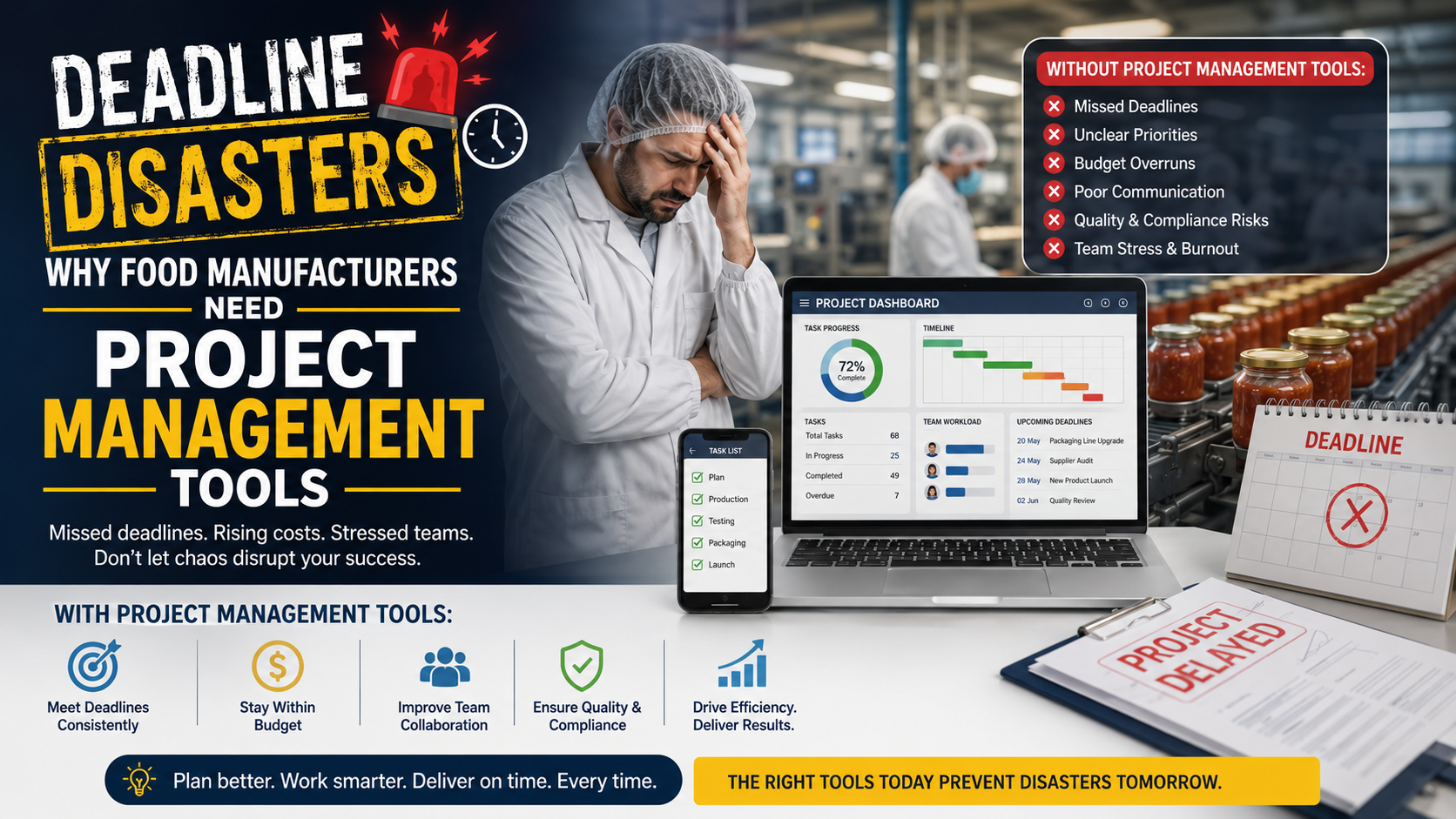
Deadline Disasters – Why Food Manufacturers Need Project Management Tools
Introduction
Receiving task requests from a variety of sources can make it difficult to manage individual workloads because it can lead to confusion over which tasks are a priority, duplication of effort, and difficulty in tracking progress. This can make it challenging to ensure that all tasks are completed on time and to the appropriate standard. Additionally, without a clear system in place for managing and assigning tasks, it can be difficult to ensure that all workers are utilising their time and skills effectively. In this post, we’ll look at the applications for project management software in food manufacturing, and the range of benefits it can bring.
As we dive into the topic, you’ll be interested to know that Food Industry Hub offers integrated management systems for food manufacturers, which you can use to strengthen your assurance processes.
Table of Contents
○ An Inbox as A To-Do List
○ Receiving Requests from All Directions
○ Project Management Software as The Way Forward
○ Project Management and The Food Industry
○ Poor Project Management and Stress
○ In Summary
An Inbox as A To-Do List
Receiving tasks by email can make it difficult to stay on top of multiple requests for a few reasons:
- Inbox overload: People may receive a large number of emails on a daily basis, making it difficult to distinguish which emails contain important tasks and which do not. This can lead to missed deadlines and overlooked tasks.
- Lack of organisation: Email inboxes are not typically designed for task management, which means that tasks can be scattered throughout an inbox and difficult to find. This can make it hard for people to keep track of what tasks they need to complete, and when they need to complete them by.
- No clear prioritisation: Emails do not usually have priority levels, so it can be hard to know which tasks are the most important to tackle first.
No real-time updates: Emails are not a real-time communication tool, so it can be difficult to know when a task has been assigned, completed, or if there are any updates or changes to the task.
All of this together makes it difficult to stay on top of multiple requests received by email.
Scattered Sources – Receiving Requests from All Directions
Tasks and actions that result from internal audits or meeting agreements can lead to disorganisation if they are managed and administered separately from the majority of requests that workers receive because it can create confusion over who is responsible for completing the tasks, and how they should be prioritised. This can lead to:
- Missed deadlines: Tasks may not be completed on time if they are not properly tracked or if there is confusion over who is responsible for completing them.
- Duplication of effort: If different individuals or teams are not aware of the tasks and actions that are being assigned as a result of internal audits or meeting agreements, they may end up working on the same tasks separately, leading to wasted time and effort.
- Lack of accountability: Without a clear system for managing tasks and actions from internal audits or meeting agreements, it can be difficult to hold individuals or teams accountable for their completion.
- Lack of visibility: If tasks and actions from internal audits or meeting agreements are not integrated with the rest of the work requests, it can be difficult for managers or supervisors to have visibility over the workload and progress of their teams.
All of this together can lead to disorganisation and inefficiency in the workplace. It is important to have a centralised system that allows to manage, track, and report on all tasks, regardless of their origin.
Project Management Software as The Way Forward
- Project management software can help counteract some of the problems that can arise from managing tasks and actions from internal audits or meeting agreements separately from other requests by:
- Providing a central location for all tasks: Project management software allows users to view, manage, and track all tasks and actions in one central location, which makes it easy for teams to stay on top of their work and prioritise tasks effectively.
- Assigning clear ownership and deadlines: Project management software allows tasks to be assigned to specific individuals or teams, with clear deadlines and milestones that can be tracked and monitored. This can help ensure that tasks are completed on time and to the appropriate standard.
- Prioritizing tasks: Project management software often allows users to prioritise tasks based on importance and urgency, which can help teams focus on the most important tasks first.
- Real-time updates and communication: Project management software often provides real-time updates and notifications, allowing teams to stay informed about the progress of tasks and any changes or updates. This also allows team members to communicate with each other and managers, to ask for help, or to provide updates about their work.Reporting and Analytics: Project management software usually provides reporting and analytics capabilities that allow managers and supervisors to have visibility over the workload and progress of their teams, and to make data-driven decisions to improve their performance.
Overall, project management software can help to counteract some of the problems that can arise from managing tasks and actions from internal audits or meeting agreements separately by providing a centralised, organised, and efficient way of managing tasks and communication, improving visibility and accountability.
Project Management and The Food Industry
There are a number of ways that project management software can be of particular benefit in the food industry:
- Compliance: The food industry is heavily regulated, and project management software can help ensure compliance by tracking and documenting all tasks and actions related to food safety, quality, and regulatory requirements.
- NPD and product launch: Following a critical patch with inputs from a number of different individuals and departments is an applied multi-stage project, ripe for improvement through software applications.
- Data and Insight: Project management software can help to collect, store and analyse data, allowing for better decision making, process improvement and cost savings, by identifying bottlenecks, inefficiencies and opportunities for improvement.
Overall, project management software can help food industry organisations streamline their operations, improve compliance, and optimise their supply chain. It allows for better coordination, communication and data-driven decision making, helping to improve the overall efficiency, quality and safety of the food production process.
How Does Poor Project Management Contribute to Stress?
Poor project management can contribute to stress in a number of ways:
- Lack of clarity and direction: If a project is not properly planned and managed, it can be difficult for team members to understand their roles, responsibilities, and priorities, which can lead to confusion and uncertainty, and increase stress levels.
- Missed deadlines and unrealistic expectations: If a project is not properly scheduled and managed, it can be difficult to meet deadlines and deliver results, which can create pressure and increase stress levels.
- Inadequate communication and collaboration: Poor project management can result in a lack of communication and collaboration among team members, which can lead to confusion, misunderstandings, and mistakes, and increase stress levels.
- Lack of accountability: If a project is not properly managed, it can be difficult to hold individuals and teams accountable for their work, which can create frustration and stress.
- Limited visibility: Without proper project management, it can be difficult for managers and supervisors to have visibility over the progress and status of a project, which can lead to uncertainty and anxiety.
- Feeling of isolation: Poor project management can lead to a lack of support and resources, which can make team members feel isolated and unsupported.
- Lack of Recognition: Poor project management can lead to a lack of recognition for the work done by team members, which can lead to demotivation and stress.
All of these factors together can create a negative working environment, where stress levels are high, employee engagement and motivation are low, and productivity and performance are negatively impacted. It’s important to have a well-structured project management approach to minimise these negative effects and to ensure that the project is completed successfully and efficiently.
In Summary
The food industry is a complex and heavily regulated industry, with a wide range of tasks and actions that need to be managed effectively in order to ensure compliance, quality, and safety. However, managing tasks and actions from internal audits or meeting agreements separately from other requests, can lead to disorganisation and inefficiency in the workplace. This can cause confusion over who is responsible for completing the tasks, and how they should be prioritised. It can also lead to missed deadlines, duplication of effort, and difficulty in tracking progress.
One solution to these challenges is project management software. By providing a central location for all tasks, assigning clear ownership and deadlines, prioritising tasks, providing real-time updates and communication, and allowing for reporting and analytics, project management software can help to streamline operations, improve compliance, and optimise the supply chain.
However, it’s important to understand that project management software is not a magic solution, it’s a tool that can help, but it needs to be used in conjunction with a well-structured project management approach. This includes clearly defined project objectives, a detailed project plan, a clear definition of roles and responsibilities, and ongoing monitoring and reporting.
Poor project management can contribute to stress in many ways, including lack of clarity and direction, missed deadlines and unrealistic expectations, inadequate communication and collaboration, lack of accountability, limited visibility, feeling of isolation, and lack of recognition. These factors can create a negative working environment, where stress levels are high, employee engagement and motivation are low, and the cultural environment is negatively impacted.
One of the key advantages of project management software is the ability to assign tasks and responsibilities to specific individuals or teams. This helps to ensure that everyone knows what they need to do, and when they need to do it. It also allows for better accountability and visibility over the progress of the project.
Another important aspect of project management software is the ability to track and monitor progress in real-time. This means that team members can see the status of tasks and actions at any time, and can communicate and collaborate more effectively. It also allows for more accurate reporting and analytics, which can help to identify areas for improvement and optimise performance.
One of the biggest challenges in the food industry is ensuring compliance with food safety, quality and regulatory requirements. Project management software can help with this by allowing organisations to track and document all tasks and actions related to compliance. This can help to minimise the risk of non-conformities and ensure that the organisation is always in compliance with the relevant regulations.
Another important aspect of project management software is the ability to prioritise tasks. This means that team members can focus on the most important tasks first, which can help to ensure that deadlines are met and that the project stays on track. It also allows for better decision making, as teams can identify and address the most critical issues first.
Project management software can help organisations in the food industry manage both internally generated requests and customer requests effectively. It allows teams to assign tasks and responsibilities to specific individuals or teams, set clear deadlines, and track progress in real-time. This can help to ensure that all requests are handled promptly and efficiently, and that customer expectations are met.
In addition to managing requests, project management software can also be used to manage proactive improvement initiatives. This means that organisations can use the software to identify areas for improvement, set goals and objectives, and track progress towards these goals. By continuously monitoring and improving processes, organisations can ensure that they are always operating at their best.