Need help? 24/7

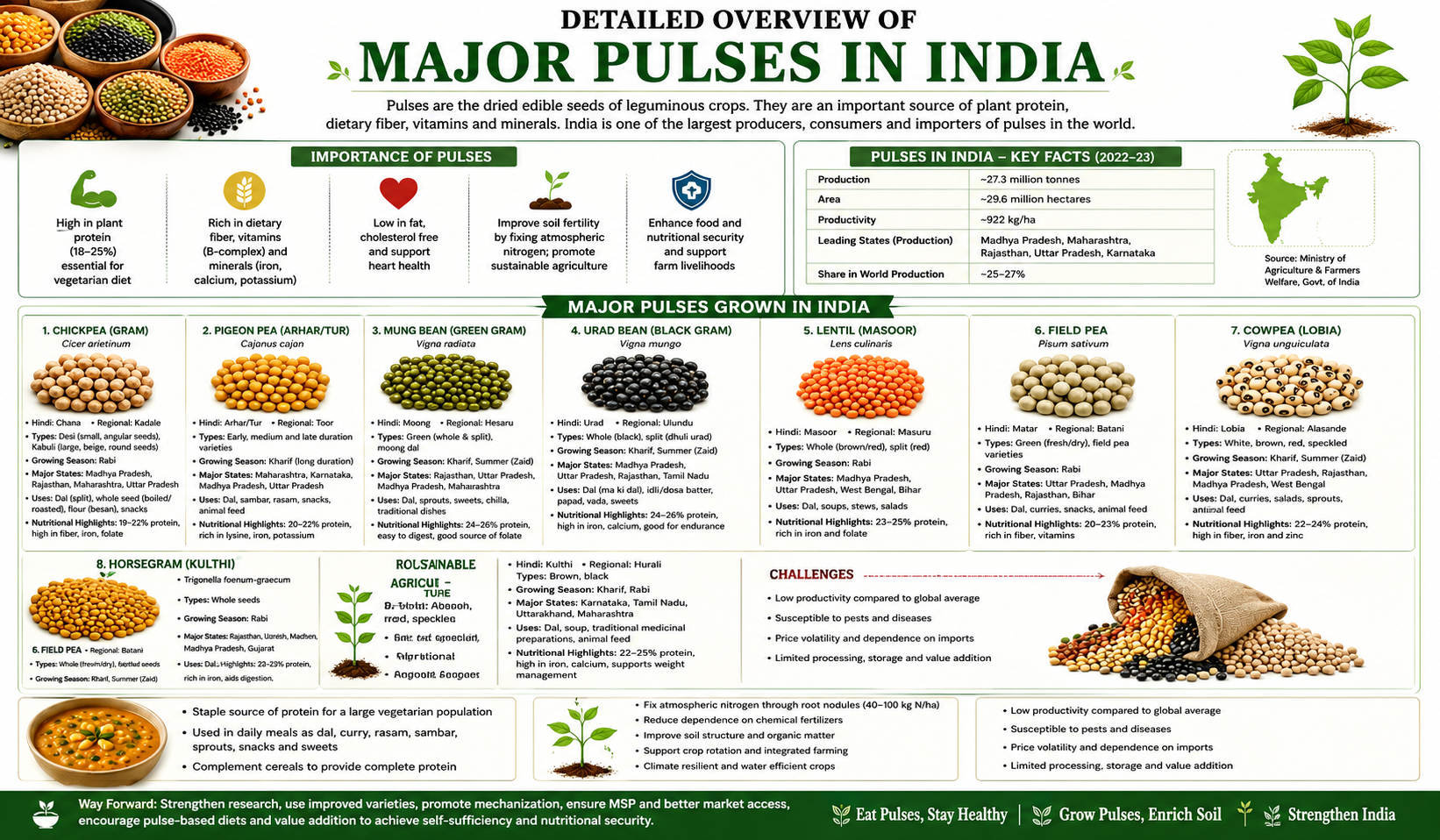
Detailed Overview of Major Pulses in India
(Arhar, Chana, Moong, Urad and Masoor)
Pulses are among the most important agricultural commodities in India and form a major part of the daily diet. India is recognized as the largest producer, consumer, and importer of pulses in the world. Pulses are the dried edible seeds of leguminous plants and are highly valued because of their rich protein content, dietary fiber, minerals, and vitamins. They are commonly consumed in the form of whole grains, split dals, sprouts, flours, and processed food products. In Indian households, pulses are considered the primary source of protein for vegetarian populations.
Pulses also play a significant role in agriculture because they improve soil fertility through nitrogen fixation. Due to their nutritional and agricultural importance, pulses are cultivated extensively across different climatic regions of India.
According to the standards prescribed by the Food Safety and Standards Authority of India (FSSAI), pulses must comply with defined quality and safety parameters related to moisture, impurities, damaged grains, infestation, and food safety requirements.
1. Classification of Pulses
Pulses are classified on the basis of processing, seed structure, and commercial usage.
Whole pulses are grains that retain their outer husk and complete seed structure. Examples include whole moong, whole urad, and whole masoor. Split pulses are obtained by splitting the grains into halves, commonly known as dal. Dehusked pulses are pulses from which the outer skin has been removed. Pulses may also be categorized as polished or unpolished. Polished pulses are treated with oil, water, or polishing agents to provide a shiny appearance, while unpolished pulses maintain their natural texture and nutritional quality.
From a botanical and commercial perspective, pulses are grouped into categories such as pigeon pea (arhar), gram pulses (chana), lentils (masoor), and bean-type pulses such as moong and urad.
1.1 Arhar Dal (Toor Dal / Pigeon Pea)
Arhar Dal is one of the most consumed pulses in India. Scientifically known as Cajanus cajan, arhar is widely used in Indian cuisine because of its mild flavor, high protein content, and versatile cooking characteristics. It is commonly referred to as Toor Dal, Tur Dal, or Pigeon Pea in different regions.
Arhar is available in multiple commercial forms including whole arhar, split arhar dal, polished arhar, and unpolished arhar. Whole arhar grains are generally brownish in color with husk, whereas split arhar dal is yellow after dehusking and splitting.
The crop is predominantly cultivated in Maharashtra, Karnataka, Madhya Pradesh, Uttar Pradesh, and Gujarat. Maharashtra is considered the leading producer in India. Internationally, countries such as Myanmar, Tanzania, Mozambique, and Malawi are important suppliers of arhar to India because domestic production often falls short of consumption demand.
Arhar dal is widely used in preparations such as sambar, dal tadka, Gujarati dal, rasam, and khichdi. The pulse contains approximately 20–22% protein and is known for its balanced taste and moderate cooking time.
From a quality perspective, arhar should have uniform grain size, bright natural color, low moisture, and freedom from infestation. One common issue in the market is artificial color application to improve appearance, which is prohibited under food safety regulations.
1.2 Chana Dal (Bengal Gram)
Chana Dal is derived from chickpeas and scientifically known as Cicer arietinum. Chana is among the oldest cultivated pulses and is highly valued for its nutritional density and industrial applications.
Chana is mainly classified into Desi Chana and Kabuli Chana. Desi chana consists of small dark brown seeds with rough texture, whereas Kabuli chana is larger, cream-colored, and smoother. Chana dal is produced by splitting and dehusking desi chana. Besan, or gram flour, is another major processed product derived from chana.
India’s major chana-producing states include Madhya Pradesh, Rajasthan, Maharashtra, and Uttar Pradesh. Madhya Pradesh contributes the highest share in national production. Internationally, Australia, Canada, Turkey, and Russia are major producers and exporters.
Chana has extensive culinary and industrial uses. It is used in dal preparation, namkeen manufacturing, sweets, snacks, besan products, and ready-to-eat foods. Due to its high fiber and protein content, chana is also considered beneficial for digestive health and blood sugar management.
Quality evaluation of chana includes parameters such as grain hardness, uniformity, moisture content, foreign matter, insect infestation, and damaged grains. Adulteration with cheaper pulses such as Kesari dal is a major concern and is strictly monitored under food safety regulations.
1.3 Moong Dal (Green Gram)
Moong Dal, scientifically known as Vigna radiata, is considered one of the easiest pulses to digest. It is highly preferred in Indian diets because of its nutritional value and light digestive properties.
Moong is available in several forms including whole moong with green husk, split moong chilka with skin, yellow moong dal without skin, and moong flour. Whole moong is widely used for sprouting purposes due to its high germination capacity and nutritional enhancement during sprouting.
The major producing states of moong in India are Rajasthan, Maharashtra, Karnataka, Andhra Pradesh, and Telangana. Rajasthan is the leading producer. Countries such as Myanmar, Thailand, and China are significant international suppliers.
Moong dal is commonly used in khichdi, dal fry, sprouts, snacks, sweets, and baby foods. It cooks quickly compared to other pulses and contains approximately 22–24% protein.
Quality assessment of moong focuses on freshness, grain uniformity, color retention, sprouting capability, and absence of damaged or shriveled grains. Color coating and artificial polishing are common malpractices observed in low-quality products.
Because of its easy digestibility and low flatulence properties, moong is widely recommended in hospitals, therapeutic diets, and elderly nutrition.
1.4 Urad Dal (Black Gram)
Urad Dal, scientifically known as Vigna mungo, is another major pulse crop extensively consumed in India. Urad has a unique sticky and binding property after grinding, making it highly suitable for fermentation-based food products.
Urad is commercially available as whole urad with black skin, split urad chilka with skin, and dhuli urad without skin. Whole urad has black outer skin and creamy white inner cotyledons.
The major producing states in India include Madhya Pradesh, Uttar Pradesh, Andhra Pradesh, Tamil Nadu, and Maharashtra. Myanmar is one of the largest exporters of urad to India due to high Indian consumption demand.
Urad plays a central role in South Indian cuisine and is widely used for making idli, dosa, vada, papad, and dal makhani. The fermentation characteristics of urad make it extremely valuable in the batter industry.
Nutritionally, urad contains approximately 24–26% protein along with iron, calcium, and dietary fiber. Quality parameters for urad include grain size, color, polishing level, absence of fungal contamination, and cooking consistency.
Improper polishing practices and moisture mismanagement can reduce the overall quality and shelf life of urad products.
1.5 Masoor Dal (Red Lentil)
Masoor Dal is scientifically known as Lens culinaris. Masoor is one of the fastest-cooking pulses and is widely consumed in northern and eastern India.
Masoor is available as whole masoor with brown outer skin and split red masoor without husk. The split variety has a characteristic reddish-orange color and soft texture after cooking.
Major producing states in India include Madhya Pradesh, Uttar Pradesh, Bihar, and West Bengal. Internationally, Canada and Australia dominate global masoor production and export markets. Canada is one of the largest suppliers of imported masoor to India.
Masoor dal is widely used in soups, curries, dal preparations, and blended food products. Due to its high iron content and quick cooking properties, it is popular in households and food service industries.
Quality evaluation of masoor includes parameters such as color consistency, grain soundness, absence of discoloration, and low broken percentage. Artificial coloring is sometimes observed in poor-quality products and is prohibited under FSSAI regulations.
2. Regional Consumption Pattern in India
Consumption patterns of pulses vary according to regional food habits. In South India, arhar and urad are dominant because of their extensive use in sambar, dosa, and idli preparations. In North India, chana and masoor are widely consumed in daily meals. Western India has a strong preference for arhar, especially in Gujarati and Maharashtrian cuisines. Eastern India commonly consumes masoor and moong due to their lighter texture and faster cooking properties.
3. International Trade of Pulses
India is the largest consumer of pulses but domestic production often fluctuates because of climatic conditions and productivity limitations. As a result, India imports significant quantities of arhar, urad, and masoor from countries such as Myanmar, Canada, Australia, Tanzania, and Mozambique.
Imported pulses are subjected to strict quality checks for pesticide residues, infestation, moisture levels, and food safety compliance before entering the Indian market.
4. Comprehensive Matrix: Types, Agronomy, and Geography
| Pulse Common Name | Major Types / Sub-categories Available | Core Sowing Season (India) | Key Producing States (India) | Major Global Producing Countries |
|---|---|---|---|---|
| Arhar / Toor | Whole with skin, Split unpolished (Dal), Oily vs. Non-oily Dal. | Kharif (June-July sowing) | Maharashtra, Madhya Pradesh, Karnataka, Uttar Pradesh, Gujarat. | India, Myanmar, Malawi, Kenya, Tanzania. |
| Chana | Desi Chana (Brown/Black), Kabuli Chana (White/Garbanzo), Chana Dal, Besan (Flour). | Rabi (October-November sowing) | Madhya Pradesh, Rajasthan, Maharashtra, Andhra Pradesh, Uttar Pradesh. | India, Australia, Ethiopia, Turkey, Canada. |
| Moong | Whole Green Moong, Split Green (with skin), Yellow Moong Dal (split & washed). | Kharif & Zaid (Summer crop) | Rajasthan, Madhya Pradesh, Maharashtra, Andhra Pradesh, Bihar. | India, China, Myanmar, Indonesia, East Africa. |
| Urad | Whole Black Urad, Split Black Urad (with skin), White Urad Dal (split & washed). | Kharif & Rabi (in Southern India) | Madhya Pradesh, Uttar Pradesh, Andhra Pradesh, Maharashtra, Tamil Nadu. | India, Myanmar, Thailand, Bangladesh. |
| Masoor | Masoor Whole (Brown/Black exterior), Masoor Malka (Split orange/red core). | Rabi (October-November sowing) | Madhya Pradesh, Uttar Pradesh, Bihar, West Bengal, Rajasthan. | Canada, India, Australia, Turkey, Nepal. |
5. FSSAI Quality Standards for Pulses
According to the standards prescribed under the Food Safety and Standards Regulations, pulses must be clean, wholesome, safe for human consumption, and free from harmful contaminants.
The general standards specify that pulses should not contain excessive foreign matter, mineral impurities, insect-damaged grains, or toxic substances. Moisture content is generally limited to 14% for whole pulses and 12% for dehusked pulses to prevent fungal growth and storage deterioration.
The permissible limits for impurities include restrictions on:
- Extraneous matter
- Mineral matter
- Broken grains
- Damaged grains
- Weevilled grains
- Discolored seeds
- Uric acid content
- Other edible grains
Pulses must also be free from added synthetic colors and harmful polishing agents.
The detailed standards are available through the official FSSAI Product Standards.
6. Quantitative Physicochemical Tolerances
FSSAI outlines uniform quantitative limits for standard pulses (whether sold as whole grains or split Dals):
| Quality Parameter / Index | FSSAI Permissible Limit / Maximum Threshold |
|---|---|
| Moisture Content | Max 14.0% by mass (For pulses without seed coats/split dals, typically capped at 12.0%) |
| Extraneous Matter (Total) | Max 1.0% by mass |
| Organic Extraneous Matter | Max 0.75% by mass (Stalks, leaves, unpalatable seed hulls) |
| Inorganic/Mineral Matter | Max 0.25% by mass (Sand, stones, dust, soil clumps) |
| Impurities of Animal Origin | Max 0.10% by mass |
| Seeds with Serious Defects | Max 1.0% by mass (Attacked by pests, visible mold, structural decay) |
| Seeds with Slight Defects | Max 7.0% by mass (Immature seeds, wrinkled skins, broken pulses) |
| Broken Pulses (Within slight defects) | Must not exceed 3.0% of the total mass |
| Other Edible Pulses | Max 2.0% by mass (Accidental cross-contamination of other grain varieties) |
| Discolored Seeds | Max 3.0% by mass |
| Uric Acid Content | Max 100 mg per kg (An essential chemical marker indicating previous rodent or insect contamination) |
| Weevilled Grains | Max 6% by count |
7. Quality Defects Observed in Pulses
The quality of pulses can deteriorate because of poor agricultural practices, improper storage, mishandling during transportation, or incorrect processing techniques.
Common physical defects include broken grains, shriveled grains, immature seeds, insect damage, discoloration, and fungal contamination. Chemical issues may include pesticide residues, artificial polishing, or addition of synthetic colorants.
Storage-related problems such as high moisture, poor ventilation, and pest infestation can lead to mold growth, bad odor, and reduced shelf life.
In commercial procurement, pulses are evaluated based on moisture, grain size, appearance, cooking quality, water absorption, infestation status, and laboratory analysis.
8. Polished and Unpolished Pulses
Polished pulses are processed using oil, leather polishers, or water treatment to enhance visual appearance and market acceptability. Although polished pulses appear shinier, the process may reduce some surface nutrients and fiber content.
Unpolished pulses retain their natural appearance and are increasingly preferred by health-conscious consumers because they are considered nutritionally superior and minimally processed.
9. Processing of Pulses
Pulse processing involves multiple stages including cleaning, grading, pitting, oil application, drying, dehusking, splitting, polishing, sorting, and packaging.
Modern dal mills use advanced machinery for color sorting, grading, and metal detection to improve product quality and food safety compliance.
Proper processing helps improve cooking quality, shelf life, and market value of pulses.
10. Nutritional Importance of Pulses
Pulses are an essential source of plant-based protein and are particularly important in vegetarian diets. They also provide carbohydrates, dietary fiber, iron, calcium, magnesium, folate, and antioxidants.
Among the major pulses:
- Moong is known for digestibility,
- Urad for fermentation,
- Chana for fiber,
- Masoor for iron content,
- Arhar for balanced taste and protein.
Regular consumption of pulses supports muscle growth, digestive health, heart health, and blood sugar management.
11. Conclusion
Arhar, Chana, Moong, Urad, and Masoor are among the most significant pulse crops in India from nutritional, agricultural, and commercial perspectives. Each pulse has unique characteristics related to cultivation, processing, cooking behavior, and regional demand. India’s pulse industry depends heavily on proper quality control, standardized processing, and compliance with FSSAI regulations to ensure consumer safety and product consistency.
Understanding pulse classification, sourcing regions, processing standards, and quality parameters is highly important for procurement teams, quality assurance departments, manufacturers, and food businesses involved in the pulse supply chain.