Need help? 24/7

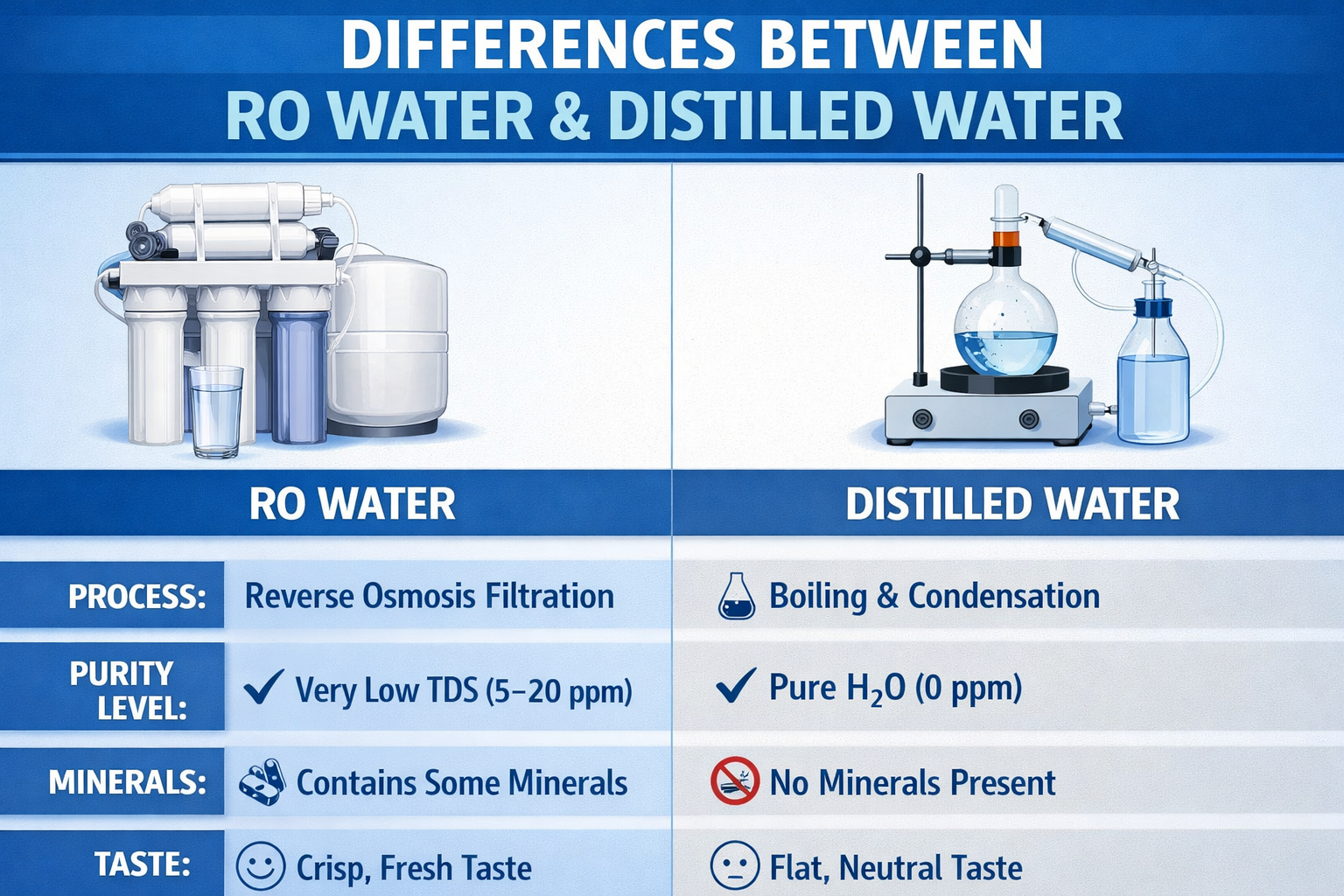
Differences Between RO Water & Distilled Water
Water is essential for life, but not all water is created equal. With increasing awareness about health, safety, and water quality, people are turning to advanced purification methods such as Reverse Osmosis (RO) and Distillation. Both processes aim to provide clean, safe water, yet they differ significantly in terms of purification method, composition, usage, and health impact.
In this detailed guide, we will explore the key differences between RO water and distilled water, helping you understand which is better suited for your needs.
What is RO Water?
Reverse Osmosis (RO) water is purified through a multi-stage filtration system that uses a semi-permeable membrane to remove impurities. The process forces water through microscopic pores that block contaminants such as salts, heavy metals, bacteria, and chemicals.
How RO Works:
- Pre-filtration removes sediments and larger particles
- Activated carbon filters remove chlorine and organic chemicals
- A semi-permeable membrane removes dissolved solids, bacteria, and heavy metals
- Optional post-filters or remineralization stages improve taste
RO systems typically remove 90–99% of contaminants, while still retaining small amounts of essential minerals like calcium and magnesium.
What is Distilled Water?
Distilled water is produced through a process called distillation, which involves boiling water and then condensing the steam back into liquid form. This process separates water from impurities, leaving most contaminants behind.
How Distillation Works:
- Water is heated until it turns into steam
- Steam rises, leaving contaminants behind
- Steam is cooled and condensed back into liquid
- Collected water is nearly pure H₂O
Distilled water is almost completely free of minerals, salts, and microorganisms, making it one of the purest forms of water available.
Key Differences Between RO Water and Distilled Water
1. Purification Process
The most fundamental difference lies in how each type of water is purified.
- RO Water: Uses pressure to push water through a semi-permeable membrane, filtering out contaminants.
- Distilled Water: Uses heat to evaporate and condense water, leaving impurities behind
Conclusion: RO is a filtration process, while distillation is a thermal separation process.
2. Level of Purity
Both methods produce highly purified water, but the degree and nature of purity differ.
- RO Water: Removes most contaminants but may leave trace minerals (10–50 ppm TDS)
- Distilled Water: Removes nearly all dissolved solids (close to 0 ppm TDS)
Distilled water is generally purer in terms of mineral removal, while RO water balances purity and usability.
3. Mineral Content
Mineral content is one of the most important differences.
- RO Water: Retains small amounts of essential minerals like calcium and magnesium
- Distilled Water: Contains no minerals at all
Minerals are important for taste and health, making RO water more suitable for daily drinking.
4. Taste and Palatability
Taste is directly influenced by mineral content.
- RO Water: Has a clean, slightly natural taste due to retained minerals
- Distilled Water: Tastes “flat” or “bland” because it lacks minerals
For regular consumption, most people prefer RO water.
5. Health Implications
RO Water:
- Provides safe drinking water
- Retains beneficial minerals (or can be re-mineralized)
- Suitable for long-term consumption
Distilled Water:
- Extremely pure but lacks nutrients
- Long-term consumption may not provide essential minerals
- Often not recommended as the sole drinking source
RO water is generally considered healthier for daily use.
6. Contaminant Removal Capability
Both methods remove harmful substances, but in different ways.
- RO Water Removes:
- Heavy metals (lead, mercury)
- Salts and dissolved solids
- Bacteria and viruses
- Chlorine and pesticides
- Distilled Water Removes:
- Most bacteria and minerals
- Heavy metals and salts
However, some volatile compounds may carry over during distillation.
RO is often more effective for removing a wider range of contaminants.
7. Energy Consumption
- RO Systems: Energy-efficient (uses pressure, not heat)
- Distillation: Energy-intensive (requires boiling water continuously)
RO is more economical for regular use.
8. Speed of Production
- RO Water: Instant or continuous supply
- Distilled Water: Slow process (can take 5–6 hours per gallon)
RO is far more practical for households.
9. Cost and Maintenance
- RO Systems:
- Higher initial installation cost
- Lower long-term cost
- Requires filter replacement
- Distillation:
- Lower setup (if buying water)
- Higher operational cost (energy consumption)
RO is more cost-effective over time.
10. Microbial Removal
- RO water : effectively removes bacteria, protozoa, and many viruses through membrane filtration. However, improper maintenance can allow microbial growth.
- Distilled water removes microorganisms by killing them during the boiling process. Both methods are effective, but distillation provides thermal destruction of microbes.
11. Environmental Impact
- RO systems generate wastewater known as reject water, which may cause water wastage if not reused.
- Distillation: High energy consumption Less sustainable for daily use. Distillation does not generate reject water but consumes more electricity, indirectly affecting the environment.
RO is more environmentally friendly overall.
12. Practicality for Home Use
- RO Water: Easy, on-demand, user-friendly
- Distilled Water: Time-consuming and impractical for large families
RO is the clear winner for household use.
13. Maintenance Requirement
- RO water: systems require regular maintenance, including membrane replacement and filter cleaning. Poor maintenance reduces water quality.
- Distillation: units require descaling and cleaning of boiling chambers to remove residue buildup. Both systems need maintenance, but RO generally requires more frequent attention.
Which One Should You Choose?
- Choose RO Water if:
- You need safe drinking water daily
- You want better taste
- You prefer balanced mineral content
- You need a practical home solution
- Choose Distilled Water if:
- You need ultra-pure water
- You are using medical or laboratory equipment
- You want mineral-free water for appliances
Common Myths About RO and Distilled Water
- Myth 1: Distilled Water is Always Better:- While distilled water is purer, it is not always better for drinking due to lack of minerals.
- Myth 2: RO Water is Not Pure Enough:- RO water removes up to 99% of contaminants, making it highly safe.
- Myth 3: Both Are the Same:- They differ significantly in process, taste, and applications.
Final Thoughts
Both RO water and distilled water are excellent purification methods, but they serve different purposes. RO water is ideal for daily consumption, offering a balance of purity, taste, and essential minerals. Distilled water is best for specialized uses requiring absolute purity and no mineral content.
In most cases, especially for households, RO water is the more practical and health-friendly option, while distilled water remains essential for industrial and medical applications.