Need help? 24/7

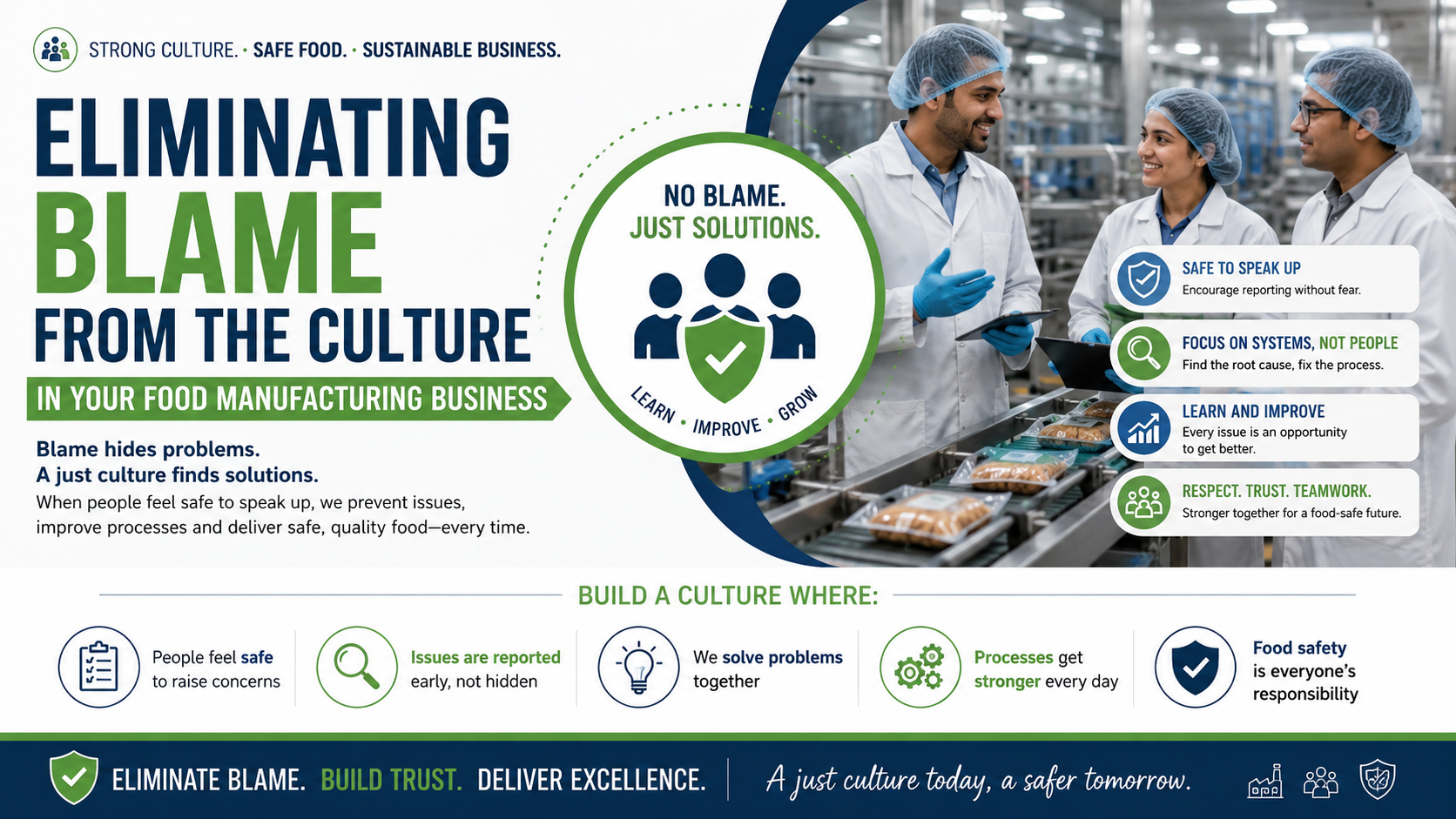
Eliminating Blame from The Culture in Your Food Manufacturing Business
Introduction
Eliminating blame from the culture of your food manufacturing business can be challenging to achieve. But having a constructive approach to reporting and analysing mistakes can lead to more positive outcomes for everyone involved.
This post will discuss how to create an atmosphere of trust, open communication, and continuous improvement in order to eliminate the culture of blame in your food manufacturing business.
By shifting away from blame towards accountability and collaboration, you can unlock the true potential of your business.
As we dive into the topic, you’ll be interested to know that Food Industry Hub offers integrated management systems for food manufacturers, which you can use to strengthen your assurance processes.
Table of Contents
○ Recognising the Impact of Blame
○ Building a Culture of Transparency
○ The Damaging Effects of a Blame Culture in Food Manufacturing
○ The Aviation Industry as an Example of Best Practice
○ Benefits of Eliminating Blame
○ In Summary
Key Takeaways
- A blame culture erodes trust and works against quality and performance improvement.
- People are guarded with information when they are motivated to avoid being blamed rather than work toward solutions.
- Blame inhibits root cause analysis and problem-solving.
- Every food manufacturer should take deliberate steps to eliminate blame from all managerial practices.
Recognising the Impact of Blame
Recognise how blame affects team dynamics and productivity in food manufacturing. Blame creates a toxic environment where team members are hesitant to take risks or share innovative ideas. When individuals fear being blamed for mistakes, they’re less likely to collaborate openly with their colleagues. This lack of collaboration hinders the team’s ability to problem-solve effectively and can lead to decreased productivity.
The presence of blame can damage morale within the team. Constantly pointing fingers and assigning fault erodes trust among team members and can create a culture of fear rather than one of cooperation. As a result, employees may become disengaged, leading to lower job satisfaction and higher turnover rates.
Building a Culture of Transparency
Blaming in the food manufacturing business creates a toxic environment that stifles innovation and collaboration; to shift towards a more productive and cohesive workplace, focus on building a culture of transparency. Transparency fosters trust among team members, allowing for open communication and accountability. Encourage employees to share both successes and failures without fear of retribution. By creating a safe space for honest discussions, you promote a culture where mistakes are viewed as opportunities for growth and improvement rather than reasons for blame.
Implement transparent processes and policies that are easily accessible to all staff. Clearly defined roles and expectations help prevent misunderstandings and confusion, reducing the likelihood of finger-pointing. Regularly communicate company goals, strategies, and outcomes to ensure that everyone is on the same page. Emphasise the importance of sharing feedback constructively and respectfully. Encourage a mindset where mistakes are seen as collective learning experiences rather than individual faults. Building a culture of transparency empowers employees, promotes collaboration, and ultimately drives success in the food manufacturing industry.
The Damaging Effects of a Blame Culture in Food Manufacturing
A blame culture in the food manufacturing industry undermines trust, stifles creativity, and hampers progress towards a successful and collaborative workplace environment. When blame becomes the default response to issues or mistakes, it creates a toxic atmosphere where employees are more focused on avoiding being blamed than on solving problems efficiently. This can lead to a lack of transparency as individuals try to cover up errors rather than addressing them openly.
Moreover, in a blame culture, employees are less likely to take risks or think outside the box for fear of being reprimanded if things go wrong. Innovation and creativity are stifled when individuals are afraid to suggest new ideas or approaches. This not only hampers the potential for growth and improvement within the company but also limits the ability to adapt to changing market demands.
A blame culture erodes trust among team members, leading to a breakdown in communication and collaboration. When individuals are quick to point fingers instead of working together to find solutions, it creates a divisive environment where teamwork is compromised. Ultimately, the damaging effects of a blame culture in food manufacturing can hinder productivity, employee morale, and overall business success.
The Aviation Industry as an Example of Best Practice
The aviation industry exemplifies best practices in fostering a culture of accountability and continuous improvement. In aviation, the focus is on safety above all else, leading to a zero-tolerance policy for blame games. When an issue arises, the priority is to understand what happened, why it happened, and how to prevent it from happening again. This approach encourages open communication, transparency, and a proactive stance towards problem-solving.
A key aspect of the aviation industry’s success is its emphasis on thorough investigation and reporting processes. Incidents are meticulously analysed to uncover root causes without assigning blame to individuals. By shifting the focus from blaming to learning, the industry ensures that lessons are embraced and improvements are made to prevent future occurrences.
The aviation industry values a strong safety culture where everyone from pilots to ground staff plays a role in maintaining high standards. This collective responsibility fosters trust and collaboration, reinforcing the importance of accountability and continuous learning. By adopting similar practices in your food manufacturing business, you can create a culture that prioritises improvement over blame, leading to enhanced safety and efficiency.
Benefits of Eliminating Blame
When blame is eliminated in a business setting, a culture of accountability and collaboration can thrive, leading to improved problem-solving and a focus on continuous learning. By shifting away from a blame-oriented environment, your food manufacturing business can experience numerous benefits.
Employees will feel more empowered to take ownership of their actions and decisions, fostering a sense of accountability throughout the organisation. This increased accountability not only improves individual performance but also enhances teamwork as colleagues work together towards common goals without fear of reprisal.
Eliminating blame from your company’s culture can help build trust between management and employees. When people feel like they are not constantly being scrutinised or blamed for their mistakes, they are more likely to communicate openly and honestly with their managers. This allows managers to better understand their team’s strengths and weaknesses, leading to improved performance overall.
Furthermore, eliminating blame encourages a more open and transparent communication style within your company. Employees are more likely to share ideas, feedback, and concerns when they feel supported rather than criticised. This open dialogue can lead to innovative solutions, process improvements, and a better understanding of potential risks.
Ultimately, by embracing a blame-free culture, your food manufacturing business can create a more positive and productive work environment where continuous learning and growth are prioritised.
Eliminating Blame from the Culture in Your Food Manufacturing Business
In a high-stakes environment like food manufacturing, the gut reaction to a mistake is often to find out who did it. When a batch fails a QA check, or an auditor notes an unapproved PPE deviation on the line, the immediate impulse can be to assign blame.
But pointing fingers doesn't fix a broken process. In fact, a blame-heavy culture is one of the greatest hidden risks to food safety and operational efficiency.
The True Cost of a Blame Culture
When employees fear penalties or public calling-out, they don't stop making mistakes — they just get better at hiding them. In food production, hidden mistakes are a ticking time bomb.
Delayed Responses: A line operator who notices a brief temperature dip during pasteurization might stay silent if they fear being blamed for delaying production.
Superficial Root Cause Analysis: If an audit finding is blamed entirely on "operator error," the actual underlying issue — like ambiguous Standard Operating Procedures (SOPs) or inadequate training — goes completely unaddressed.
High Turnover: Quality Assurance (QA), Quality Control (QC), and production staff burn out rapidly when they feel they are constantly walking a tightrope.
Shifting from "Who" to "Why"
Eliminating blame doesn't mean eliminating accountability. True accountability means looking at the system that allowed the mistake to happen.
Most deviations in a food plant happen because of systemic gaps, not intentional negligence. If an employee skips a sanitation step, a blame-first approach asks, "Why didn't you follow the rules?" A blameless approach asks, "Was the line moving too fast? Was the sanitizer easily accessible? Was the training clear?"
4 Steps to Build a Blameless Culture
Shifting a factory's culture requires moving from reactive discipline to proactive system analysis.
- Separate Human Error from Recklessness:- True human error happens when someone tries to do the right thing but fails due to fatigue, distraction, or a confusing process. Recklessness is an intentional disregard for safety standards. Treat human error as a data point to improve the system, while reserving disciplinary action strictly for intentional violations.
- Revamp Your Root Cause Analysis (RCA):- If your accident or deviation reports routinely conclude with "Employee retrained," your culture is likely still leaning on blame. Training is rarely the real root cause. Use the 5 Whys methodology to look deeper into equipment design, scheduling pressures, and documentation clarity.
- Reward Near-Miss Reporting:- The best way to prevent a recall is to catch the error before the product leaves the facility. Encourage operators to report near-misses — like a metal detector falsely triggering or a seal wrapper acting up. When employees are celebrated for flagging potential hazards instead of being penalized for "slowing down the line," transparency thrives.
- Align Production and Quality Goals:- Often, blame festers in the friction between the production team (driven by volume and throughput) and the QA/QC team (driven by compliance and safety). Ensure leadership evaluates both departments on shared metrics, like First-Time-Right (FTR) yield, so that safety and output are viewed as two sides of the same coin.
The Bottom Line
A blameless culture isn't a "soft" approach to management; it is a rigorous strategy for risk reduction. By focusing on fixing the process rather than punishing the person, you unlock the collective eyes and ears of your entire workforce. In food manufacturing, a transparent team is your absolute best defense against a quality failure.
In Summary
By eliminating blame from your food manufacturing business, you can foster a culture of transparency and accountability. This shift won’t only improve employee morale and teamwork, but also enhance overall operational efficiency and quality control.
Take inspiration from the aviation industry’s best practices and reap the benefits of a blame-free environment in your own organisation. Start today and watch your business thrive.