Need help? 24/7

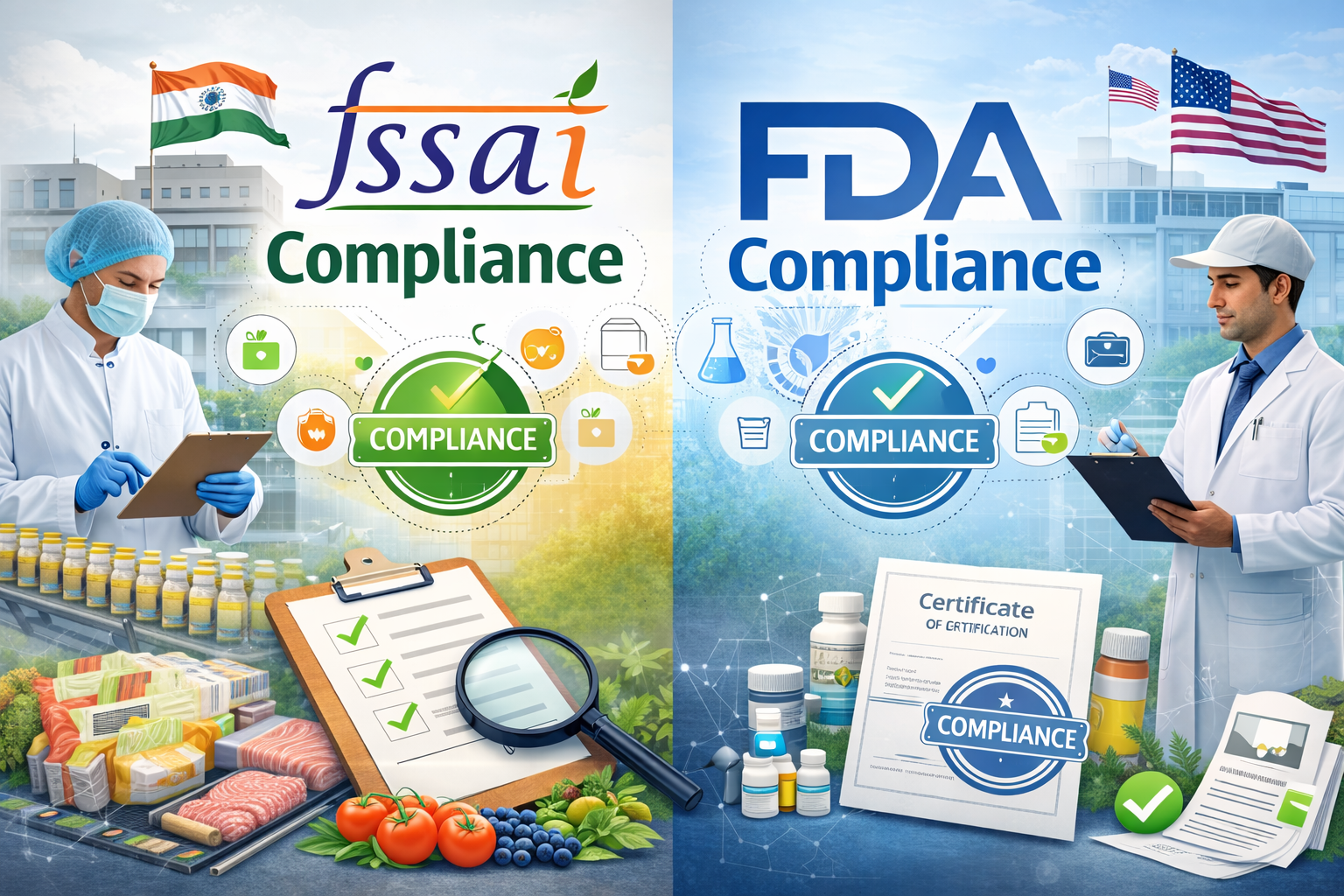
Differences Between FSSAI Compliance & FDA Compliance
0. Introduction
Food safety compliance is a critical pillar of public health and global trade. Regulatory authorities worldwide ensure that food products are safe, hygienic, and accurately labeled. Two of the most prominent regulatory frameworks are:
- Food Safety and Standards Authority of India (FSSAI)
- U.S. Food and Drug Administration (FDA)
While both organizations aim to safeguard consumer health, their regulatory structures, implementation approaches, and compliance requirements differ significantly.
This detailed guide explores the core differences, similarities, and practical implications of FSSAI and FDA compliance.
0.1 Regulatory Overview
0.1.1 FSSAI (India)
FSSAI is the apex food regulatory body in India, established under the Food Safety and Standards Act, 2006.
Key Responsibilities:
- Setting food safety standards
- Licensing and registration of Food Business Operators (FBOs)
- Regulating manufacturing, storage, distribution, sale, and import
- Promoting food safety awareness
FSSAI consolidates multiple earlier food laws into a single framework, ensuring uniformity across India.
0.1.2 FDA (USA)
The FDA operates under the Federal Food, Drug, and Cosmetic Act, with significant enhancements through the Food Safety Modernization Act.
Key Responsibilities:
- Ensuring safety of food, drugs, cosmetics, and medical devices
- Regulating domestic and imported food products
- Enforcing preventive controls and risk-based systems
- Conducting inspections and recalls
0.1.3. Scope and Coverage
| Aspect | FSSAI | FDA |
|---|---|---|
| Jurisdiction | India | United States |
| Coverage | Food products only | Food, drugs, cosmetics, devices |
| Applicability | Domestic & imported food | Domestic & imported food |
| Target Entities | FBOs | Food facilities, importers |
Key Difference:
- FSSAI is food-specific, whereas FDA is a multi-sector regulator.
1. Structural and Jurisdictional Differences
The fundamental difference lies in the scope of authority.
FSSAI: The Singular Food Sentinel
Established under the Food Safety and Standards Act, 2006, FSSAI consolidated eight older laws (like the Prevention of Food Adulteration Act) into a single regulatory body. Its primary focus is food only. It operates under the Ministry of Health & Family Welfare.
US FDA: The Multidisciplinary Giant
The FDA, governed primarily by the Federal Food, Drug, and Cosmetic Act (FD&C Act) and the modern Food Safety Modernization Act (FSMA), has a far wider reach. Beyond food, it regulates human and veterinary drugs, biological products, medical devices, cosmetics, and tobacco.
2. Compliance Framework: License vs. Registration
FSSAI Licensing System
FSSAI operates on a tier-based licensing system determined by the capacity and turnover of the Food Business Operator (FBO):
- Basic Registration: For petty food businesses (Turnover < ₹12 Lakhs).
- State License: For medium-sized businesses (Turnover ₹12 Lakhs to ₹20 Crores).
- Central License: For large-scale manufacturers, importers, and multi-state operations (Turnover > ₹20 Crores).
FDA Registration System
The FDA does not "license" food facilities in the same way. Instead, under FSMA, domestic and foreign facilities that manufacture, process, pack, or hold food for human or animal consumption in the US must register with the FDA. This is a mandatory administrative step but does not imply "approval" of the facility.
3. Preventive Controls and Safety Standards
Both agencies rely on Science-Based Standards, but their implementation protocols differ.
| Aspect | FSSAI Compliance | US FDA Compliance |
|---|---|---|
| Core Protocol | Relies on Schedule 4 (GHP/GMP) and HACCP. | Relies on HARPC (Hazard Analysis and Risk-Based Preventive Controls). |
| Philosophy | Prescriptive: Detailed rules on what is allowed. | Preventive: Focuses on identifying and preventing hazards before they occur. |
| Food Additives | Uses a "Positive List" (if it’s not listed, it’s not allowed). | Uses GRAS (Generally Recognized as Safe) and food additive petitions. |
4. Labeling and Nutritional Disclosure
Labeling is one of the most visible areas of divergence for compliance.
- FSSAI Labeling (FSS Packaging and Labelling Regulations)
- Veg/Non-Veg Logo: Mandatory (Green circle for veg, Brown triangle for non-veg).
- FSSAI Logo & License Number: Must be displayed on the principal display panel.
- Ingredient List: In descending order of weight.
- Fortification: "F+" logo required for fortified foods.
- FDA Labeling (Nutrition Facts Label)
- Nutrition Facts Panel: Highly standardized format with specific font size requirements.
- Added Sugars: Must be explicitly declared (a relatively recent requirement).
- Allergen Labeling: Must follow the FALCPA (Food Allergen Labeling and Consumer Protection Act), identifying the "Big 9" allergens.
- No Veg/Non-Veg Requirement: There is no federal requirement for vegetarian symbols.
5. Import and Export Compliance
Importing to India (FSSAI)
Every imported shipment is subjected to a 100% visual inspection and sampling. The product must have a "Shelf Life" of at least 60% remaining at the time of entry.
Importing to the US (FDA)
The FDA uses a risk-based screening system called PREDICT. Instead of sampling every shipment, it uses data analytics to target high-risk products. Importers must also comply with the FSVP (Foreign Supplier Verification Program), essentially making the US importer responsible for the safety of the foreign supplier.
6. Inspection and Enforcement
FSSAI Enforcement
- Food Safety Officers (FSOs): Conduct unannounced inspections and draw samples.
- Penalties: Can range from fines for "misbranded" food to imprisonment for "unsafe" food.
- Improvement Notices: Given to FBOs to correct deficiencies within a timeframe.
FDA Enforcement
- Form 483: Issued at the end of an inspection if investigators observe conditions that may violate FDA requirements.
- Warning Letters: Publicly available letters sent for significant violations.
- Recalls: While mostly voluntary, the FDA has the authority to mandate a recall under FSMA if a product poses a threat.
7. Temperature Control: A Technical Snapshot
| Standard | Refrigerated Food | Frozen Food |
|---|---|---|
| FSSAI | < 5°C | -18°C or colder |
| FDA | <41°F | No specific federal temp, but must be "solidly frozen" |
Summary for Professionals
For a Food Technologist or Academic Writer, the key takeaway is that FSSAI is more prescriptive (telling you exactly what to do), whereas FDA is more systems-oriented (requiring you to prove that your specific process is safe through HARPC).