Need help? 24/7

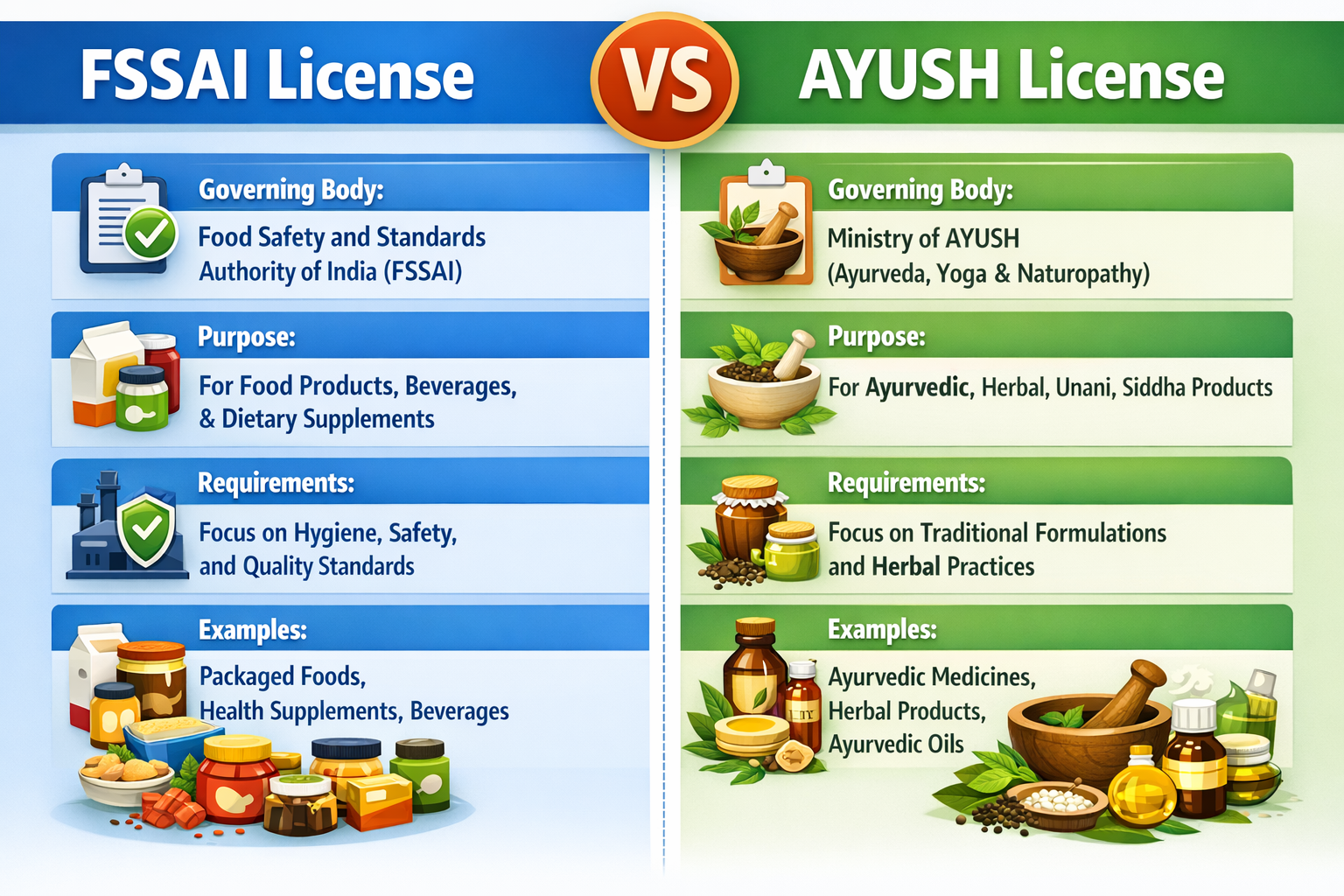
FSSAI License vs AYUSH License: A Detailed Comparative Guide with Examples
In India’s highly regulated food and health product landscape, understanding the difference between regulatory frameworks is essential for manufacturers, marketers, and entrepreneurs. Two commonly confused regulatory systems are the Food Safety and Standards Authority of India (FSSAI) and the Ministry of AYUSH (AYUSH). While both deal with products consumed for health and well-being, they operate under entirely different laws, objectives, and licensing systems.
This blog provides a detailed comparison between FSSAI licensing and AYUSH licensing, including definitions, applicability, regulatory frameworks, product scope, compliance requirements, and real-world examples.
1. Understanding FSSAI License
The Food Safety and Standards Authority of India is the apex food regulatory authority in India, established under the Food Safety and Standards Act, 2006. Its primary role is to ensure that food products are safe, hygienic, and suitable for human consumption.
1.1 What is an FSSAI License?
An FSSAI license is a mandatory certification required for any business involved in:
- Manufacturing food products
- Processing or packaging food
- Storage and distribution
- Retail or food service
Whether it is a small home-based food startup or a large food processing company, FSSAI registration or licensing is compulsory.
1.2 Types of FSSAI Licenses
- Basic Registration – For small businesses (turnover < ₹12 lakh)
- State License – Medium-sized businesses
- Central License – Large-scale operations or import/export
1.3 Scope of FSSAI
FSSAI governs:
- Packaged foods
- Beverages
- Dairy products
- Meat and seafood
- Nutraceuticals and health supplements (regulated as food products)
1.4 Key Compliance Requirements
- Food safety management systems (FSMS)
- Proper labeling (nutritional info, ingredients, allergens)
- Hygiene and sanitation practices
- Testing of food products in approved labs
- Traceability and recall mechanisms
2. Understanding AYUSH License
The Ministry of AYUSH governs traditional systems of medicine in India, including:
- Ayurveda
- Yoga & Naturopathy
- Unani
- Siddha
- Homeopathy
2.1 What is an AYUSH License?
An AYUSH license is required for manufacturing and marketing traditional medicinal products such as:
- Ayurvedic medicines
- Herbal formulations
- Classical and proprietary medicines
Unlike FSSAI, AYUSH deals with medicinal products, not general food items.
2.2 Regulatory Framework
AYUSH licensing operates under:
- Drugs and Cosmetics Act, 1940
- Relevant state drug licensing authorities
2.3 Types of AYUSH Products
- Classical medicines (based on ancient texts)
- Proprietary medicines (modern formulations using traditional ingredients)
- Herbal cosmetics (in some cases)
2.4 Key Compliance Requirements
- Good Manufacturing Practices (GMP) certification
- Qualified Ayurvedic/Unani/Homeopathy experts
- Product formulation approval
- Raw material authentication
- Stability and safety data
3. Key Differences Between FSSAI and AYUSH
3.1 Nature of Regulation
- FSSAI regulates food products, while AYUSH regulates medicinal products.
- FSSAI: Focus on food safety and hygiene while AYUSH: Focus on therapeutic efficacy and safety
3.2 Legal Framework
- FSSAI: Food Safety and Standards Act, 2006
- AYUSH: Drugs and Cosmetics Act, 1940
3.3 Product Classification
This is where confusion often arises.
| Product Type | Regulatory Authority |
|---|---|
| Energy drink | FSSAI |
| Herbal juice (non-medicinal claim) | FSSAI |
| Ayurvedic immunity booster (with claims) | AYUSH |
| Herbal tablets for disease treatment | AYUSH |
3.4 Claims and Labeling
- FSSAI products cannot claim to cure diseases
- AYUSH products can make therapeutic claims (if approved)
Example:
- A turmeric drink marketed as “healthy beverage” → FSSAI
- A turmeric formulation marketed as “arthritis treatment” → AYUSH
3.5 Manufacturing Requirements
- FSSAI: Basic hygiene and food safety systems
- AYUSH: Mandatory GMP certification & Qualified practitioners required
3.6 Approval Process
FSSAI:
- License based on business size and activity
- Product approval needed for certain categories (e.g., nutraceuticals)
AYUSH:
- Product-wise approval required
- Licensing authority evaluates formulation
4. Practical Examples for Better Understanding
Example 1: Aloe Vera Juice
A company launches aloe vera juice.
- If marketed as a refreshing health drink → FSSAI license
- If marketed as a medicine for digestion or detoxification → AYUSH license
Example 2: Herbal Immunity Booster
A powder containing herbs like tulsi, giloy, and ashwagandha.
- Sold as a dietary supplement → FSSAI
- Sold as an Ayurvedic medicine for immunity enhancement → AYUSH
Example 3: Protein Powder
Standard whey protein → FSSAI
Herbal protein with medicinal claims → Could fall under AYUSH depending on claims
5. Overlapping Areas and Industry Confusion
In recent years, the rise of nutraceuticals, functional foods, and herbal products has blurred the line between FSSAI and AYUSH.
Common Overlaps
Herbal drinks, Dietary supplements,Immunity boosters, Functional foods
This overlap creates confusion for businesses regarding:
- Which license to obtain
- What claims to make
- How to label products
Regulatory Clarity
FSSAI has introduced specific regulations for:
- Nutraceuticals
- Health supplements
- Functional foods
However, if a product makes medicinal claims, it automatically falls under AYUSH.
6. Documentation and Licensing Process
FSSAI Licensing Documents
- Business registration proof
- Layout plan of facility
- Food safety management plan
- List of products
- Identity and address proof
AYUSH Licensing Documents
- Manufacturing license application
- GMP certificate
- Product formulation details
- Qualified technical staff details
- Raw material sourcing information
7. Compliance Challenges
FSSAI Challenges
- Frequent updates in regulations
- Labeling compliance issues
- Product testing requirements
AYUSH Challenges
- Complex approval process
- Requirement of qualified experts
- Scientific validation of claims
8. Penalties for Non-Compliance
FSSAI:
- Monetary penalties
- License suspension or cancellation
- Product recall
AYUSH:
- Legal action under Drugs and Cosmetics Act
- Seizure of products
- Manufacturing ban
9. Which License Should You Choose?
The choice depends on your product’s intended use and claims.
- Choose FSSAI if:
- Your product is food or beverage
- No medicinal claims are made
- Focus is on nutrition and wellness
- Choose AYUSH if:
- Your product is intended to treat or prevent diseases
- Based on traditional medicine systems
- Requires therapeutic claims
10. Conclusion
Both the Food Safety and Standards Authority of India and the Ministry of AYUSH play crucial roles in safeguarding public health in India, but they operate in distinct domains.
FSSAI ensures that the food we consume is safe, hygienic, and properly labeled, while AYUSH ensures that traditional medicinal products are effective, standardized, and safe for therapeutic use.
For businesses, the key lies in correctly identifying product classification and intended claims. A wrong choice of license can lead to regulatory complications, penalties, and loss of market credibility.
As the market continues to grow in health-conscious and herbal products, understanding the difference between FSSAI and AYUSH is not just important—it is essential for compliance, branding, and long-term success.