Need help? 24/7

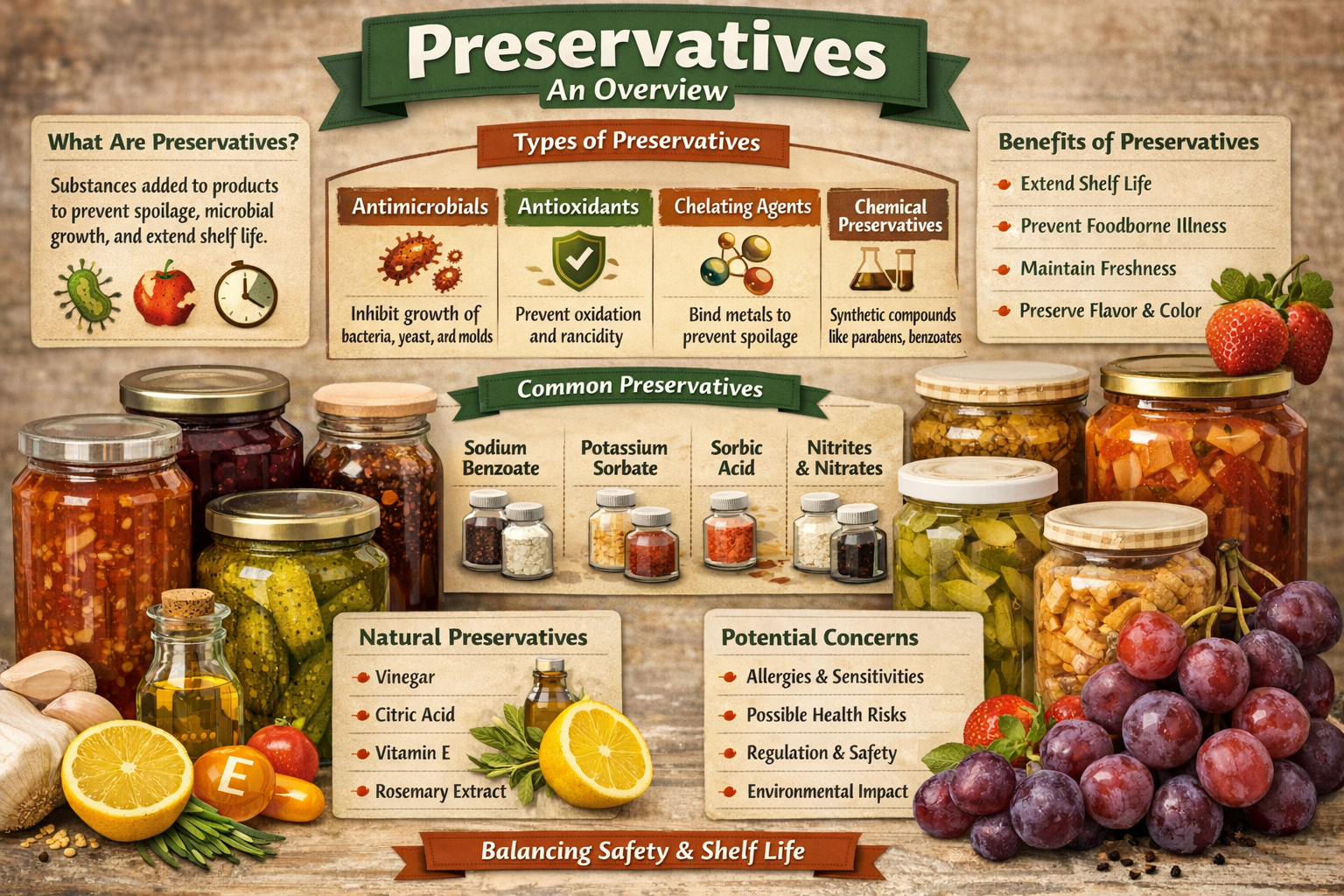
Overview Of Preservatives
Preservatives play a vital role in modern food systems by helping maintain freshness, safety, and shelf life. Whether in packaged foods or homemade products, preservatives prevent spoilage and protect against harmful microorganisms.
Preservatives are substances added to food, beverages, pharmaceuticals, or cosmetics to prevent spoilage caused by microorganisms, oxidation, or chemical changes.
They help:
- Extend shelf life
- Maintain flavor, color, and texture
- Reduce food waste
- Ensure safety during storage and transport
How Preservatives Work
Preservatives generally function through two main mechanisms:
- Antimicrobial Action: Inhibiting the growth of bacteria, fungi, and molds that cause spoilage or foodborne illness.
- Antioxidant Action: Slowing down the oxidation of fats and lipids, which prevents rancidity and maintains the product's color and flavor
Types of Preservatives
Preservatives are broadly classified into two main categories:
- Natural Preservatives: Natural preservatives are derived from plants, animals, or minerals and have been used for centuries in traditional food preservation. They are increasingly popular in "clean label" products. Common Examples:
- Salt & Sugar: These work by drawing water out of microbial cells through osmosis, effectively dehydrating and killing them.
- Vinegar (Acetic Acid): Creates an acidic environment that most pathogens cannot survive in.
- Rosemary Extract: A potent natural antioxidant often used to prevent oils from going rancid.
- Honey: Contains high sugar content and enzymes that produce hydrogen peroxide, acting as a natural antimicrobial.
- Citric Acid: Derived from citrus fruits; it lowers pH levels and acts as an antioxidant.
- Spices (e.g., turmeric, cloves) – Contain natural antioxidants
- Synthetic Preservatives: Synthetic preservatives are chemically produced. They are often more potent and cost-effective than natural alternatives, requiring very small amounts to achieve a long shelf life. Common Examples:
- Benzoates (e.g., Sodium Benzoate): Widely used in acidic foods like carbonated drinks, salad dressings, and fruit juices.
- Sorbates (e.g., Potassium Sorbate): Highly effective against molds and yeasts; commonly found in cheese, wine, and baked goods.
- Nitrites and Nitrates: Specifically used in cured meats (like bacon and ham) to prevent the growth of Clostridium botulinum and maintain pink color.
- Sulfites: Used in dried fruits and winemaking to prevent browning and bacterial spoilage.
- BHA & BHT: Synthetic antioxidants used in oils and cereals to prevent the oxidation of fats.
Differences between Synthetic Preservatives & Natural Preservatives
Source of Origin
Synthetic preservatives are chemically manufactured compounds produced through industrial chemical processes. They are designed to provide consistent preservation effects across batches. Synthetic ones are favored where uniformity and scalability are required.
Natural preservatives, on the other hand, are derived from plant, animal, or microbial sources such as herbs, spices, fruits, or fermentation by-products. Their origin strongly influences consumer perception, labeling claims, and regulatory categorization. Natural options are often associated with “clean-label” and minimally processed foods.
Chemical Composition
- Synthetic preservatives usually have a well-defined chemical structure with high purity and stability, such as benzoates or sorbates. Their composition allows predictable antimicrobial or antioxidant action.
- Natural preservatives contain complex mixtures of bioactive compounds like phenolics, flavonoids, or organic acids. This complexity may lead to variable performance depending on source and processing.
However, it may also offer multiple functional benefits beyond preservation.
Effectiveness & Potency
- Synthetic preservatives are generally more potent and effective at very low concentrations. They provide strong inhibition against bacteria, yeasts, and molds over a wide range of conditions.
- Natural preservatives may require higher doses to achieve similar effects. Their antimicrobial action can be milder and sometimes selective. As a result, natural preservatives are often used in combination or hurdle technology.
Shelf-Life Extension
- Synthetic preservatives significantly extend shelf life, making them suitable for long-distance transport and extended storage. They perform reliably under varying temperature and humidity conditions.
- Natural preservatives usually offer moderate shelf-life extension. Their effectiveness can be influenced by storage conditions and product formulation. They are preferred in fresh, minimally processed, or short-shelf-life foods.
Stability During Processing
- Synthetic preservatives are highly stable during heat treatment, pH changes, and mechanical processing. This makes them ideal for canned, baked, and highly processed foods.
- Natural preservatives may degrade or lose activity during high-temperature processing. Some natural compounds are sensitive to light, oxygen, or heat. Careful formulation and process control are required when using them.
Spectrum of Antimicrobial Activity
- Synthetic preservatives often have a broad-spectrum antimicrobial effect. They can simultaneously inhibit bacteria, molds, and yeasts.
- Natural preservatives may show selective antimicrobial action.
For example, some plant extracts are more effective against fungi than bacteria. This selectivity can be advantageous or limiting depending on the product.
Impact on Sensory Properties
- Synthetic preservatives are usually neutral in taste, color, and aroma when used within permitted limits. They rarely alter the sensory profile of food.
- Natural preservatives may influence flavor, aroma, or color due to their bioactive compounds. This can enhance product appeal in some cases, such as herbal or spiced foods. In other cases, it may require flavor masking or reformulation.
Consumer Perception & Acceptance
- Synthetic preservatives are often viewed negatively by health-conscious consumers. They are associated with “artificial” or “chemical” food images.
- Natural preservatives enjoy higher consumer trust and acceptance. They align well with clean-label, organic, and wellness-focused trends. Consumer perception increasingly drives industry preference toward natural options.
Safety & Health Concerns
- Synthetic preservatives are approved based on toxicological evaluations and acceptable daily intake (ADI) limits. However, some have been linked—rightly or wrongly—to allergies or hyper-sensitivity concerns.
- Natural preservatives are generally perceived as safer due to their natural origin. Yet, they are not inherently risk-free and can cause reactions at high doses. Safety depends on dose, purity, and regulatory compliance, not just origin.
Regulatory Status
- Synthetic preservatives are strictly regulated with defined maximum permissible limits. Their usage is clearly listed and controlled by food safety authorities.
- Natural preservatives may fall under food ingredients, extracts, or GRAS categories. Regulatory approval varies depending on country and source.
Labeling requirements can differ significantly between the two types.
Cost & Economic Feasibility
- Synthetic preservatives are generally cost-effective and economical for large-scale production. They offer consistent performance at low cost per unit.
- Natural preservatives are often more expensive due to raw material sourcing and extraction processes. Costs may fluctuate based on season and availability.
This can impact product pricing and profit margins.
Application in Clean Label Products
- Synthetic preservatives are less compatible with clean-label and organic food positioning. They may limit marketing claims related to naturalness.
- Natural preservatives strongly support clean-label, organic, and “free-from” claims. They help brands differentiate in premium and health-oriented markets.
- This makes them strategically valuable despite technical challenges.
Future Trends & Industry Preference
- Synthetic preservatives will continue to be used where high stability and long shelf life are essential. They remain important in mass-produced and export-oriented foods.
- Natural preservatives are gaining rapid popularity due to changing consumer preferences. Advances in extraction, encapsulation, and synergistic blends are improving their effectiveness.
The future points toward a balanced, hybrid approach using both types wisely.
Preservatives—whether natural or synthetic—are essential for maintaining food quality and safety. While natural preservatives appeal to health-conscious consumers, synthetic ones offer stronger protection and longer shelf life. The ideal choice depends on the product, storage needs, and consumer preferences.