Need help? 24/7

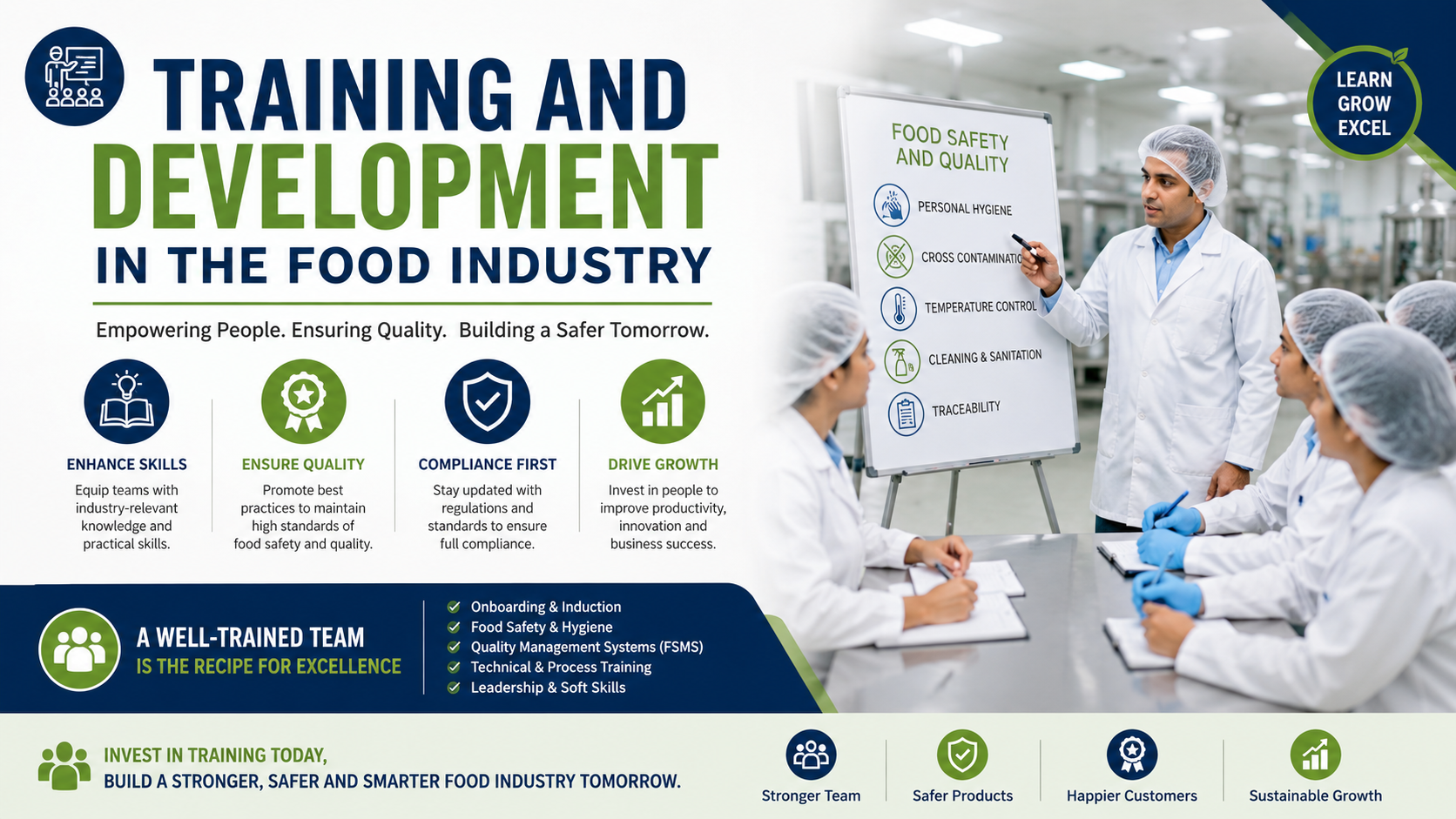
Training and Development in The Food Industry
Introduction
As a group of professionals, people in the food industry tend to be as passionate about building their professional expertise as they are about the profession itself.
Every time opportunities for professional development are made available, people are enthusiastic about engaging. With that in mind, this post brings together some free training resources that have been made available by global authorities. This is to make it easy for professionals in the food manufacturing industry to find and make use of these resources. We’ll also offer a little advice over professional development approaches.
The modern food landscape has fundamentally transformed. Between the FDA’s Food Traceability Rule going into effect, the massive expansion of automated case packing and AI-driven sorting, and a sustained labor crunch where 36% of food manufacturers cite training as their primary employee retention strategy, upskilling is no longer a footnote—it is an operational lifeline.
Moving from Classroom to "Microlearning"
The fast-paced reality of food manufacturing and food service leaves very little room for eight-hour classroom seminars. Taking operators off a high-speed line results in immediate margin loss.
Forward-thinking food brands are shifting toward microlearning—delivering bite-sized, highly focused pieces of training directly on the floor.
How it works: Short 3-to-5 minute interactive modules accessed via mobile devices or floor kiosks during natural operational gaps.
The Focus: Instead of generalized safety lectures, microlearning zeroes in on highly specific, hyper-relevant execution points (e.g., a quick tutorial on a specific allergen changeover protocol for Line 4).
Immersive Safety: VR and AR on the Floor
If a worker improperly sanitizes a complex industrial slicer, it creates a vector for Listeria or physical contamination. But training a new hire on live, dangerous, or highly expensive equipment carries massive inherent risks.
To bridge this gap, the industry is increasingly adopting Virtual Reality (VR) and Augmented Reality (AR).
Virtual Reality (VR): Immersive simulations allow a technician to practice emergency troubleshooting or complex allergen washdowns in a digital twin sandbox, experiencing zero real-world risk or material waste.
Augmented Reality (AR): Operators wearing smart glasses or looking through tablets can see digital checklists overlaid onto physical machinery. The AR system highlights exactly which valve to turn or where a critical sensor is located during live operations.
The Compliance Shift: Building a Culture, Not a Paper Trail
Compliance training used to be about survival—passing the SQF (Safe Quality Food) or BRCGS audit. However, regulatory agencies and modern auditors are shifting focus from static paperwork to real-time workforce competency.
Modern development programs tie daily behavioral metrics directly into training. If data from an automated processing line shows a frequent temperature control variance, the system automatically triggers a targeted, multilingual refresher module for that shift's team. Training is adaptive, treating food safety as a lived cultural value rather than an annual test.
Upskilling for the "FoodTech" Shift
As facilities integrate AI-driven predictive maintenance and robotic automation to battle labor shortages, the definition of a "food worker" is changing.
According to recent food tech data, organizations succeeding in automation spend nearly as much time training operators to use and interpret digital tools as they do installing the machinery itself.
Frontline teams must be upskilled to manage human-machine interfaces (HMIs), monitor IoT sensor data for predictive maintenance, and troubleshoot advanced machinery. Investing in your team's technical fluency protects your physical equipment investment and dramatically reduces unplanned downtime.
The Ultimate ROI: Retention
When food businesses treat frontline workers like disposable labor, they get a 70%+ turnover rate. Conversely, when organizations build a clear, structured upskilling path, they see a massive cultural shift. Workers stay because they see a trajectory from line operator to quality assurance technician, or from line cook to kitchen manager.
In a world driven by tight margins and strict compliance, the equation is simple: More knowledge = fewer errors = higher yield = better retention.
Training and Professional Development
There are many training and professional development resources available across the internet, and we encourage all professionals to search every now and again, to see if any new professional development tools have become available.
The resources included here are directly applicable to the field of food manufacturing – but as a point of interest, we’d also like to promote learning across different disciplines.
If you want to promote behaviour and culture change, you might really benefit by learning about things like behavioural economics and game theory, for example. Neither of these subjects have anything to do with food manufacturing directly – but there are transferable concepts that you can use practically and managerially.
It can also be good to consider pursuing training for professional skills rather than specific competencies. It doesn’t matter what function you specialise in – so this applies equally to NPD technologists and production managers: consider taking a course in lead generation and sales. You can develop better persuasion and networking skills, and that’s good for your career no-matter what field you’re in. These things are really practical, too – so you actually learn how to engage with people and initiate conversations at networking events and things. The social skills that contribute to career advancement are learned – so you can intentionally develop them by seeking out training opportunities.
Be Proactive About Your Own Development
For most people, commitment to a career is an investment as much as it is a calling. You’re investing thousands of hours, so you need to be intentional about your aspirations and how you’re going to achieve them.
This takes real consideration. Consider this: Some people reinvest into their career success over and over by going on lots of training courses. This will help them to earn more money in the future.
More knowledge and skills = more value = more money.
If you’re offering internal auditing as an interim, a food manufacturer will agree a day rate that reflects your ability to carry out internal audits. You can have a doctorate in microbiology if you want, but it won’t influence the amount the food manufacturer is willing to pay for a day of internal auditing.
There are all sorts of reasons that you might want to take courses that aren’t motivated by financial reward, but realistically, when professionals invest in their skills it’s usually with the hope that it will enable them to market their skills at a higher level.
The key things to think about are:
What’s your goal?
A promotion? A pay rise? Long-term advancement?
What knowledge or skills do you need to acquire to advance your goals?
Take into account your strengths and weaknesses, and be as critical as you can in identifying the range of knowledge and experience you would need to be successful.
Consider cost and reward.
Training and development courses can accelerate your career progression, but you should think carefully about which ones will actually add tangible value.
Apply yourself and progress.
Really commit to learning and continuous development. You are the beneficiary of your skills investment. You have a 100% ownership stake in your professional journey.
Personal Development Plans
Employers who are invested in the advancement of their employees will use personal development plans to agree career goals, and create opportunities to develop into progressive roles.
As an employee, you can really benefit from this – but only if your personal development plan is in alignment with your actual career aspirations. It’s important to communicate openly with your manager about what you’re hoping your development plan will progress you toward, and agree how you can advance in a way that benefits both yourself and the business.
A personal development plan should clearly outline development expectations for both the employer and the employee.
You should never shy away from requesting training and development resources, by the way. The worst thing that can happen is that the person saying “no” now knows you to be enthusiastic and driven.
In Summary
There are free and paid training materials available to food industry professionals across different providers.
It’s prudent to think carefully about how you can best invest in your own career success – accumulating skills that match your goals and aspirations.
Learning about different disciplines can yield insights that you cant plan for, so it’s worth dedicating at least some time and effort to broadening your skills across different fields and disciplines.
You are ultimately accountable for your own career. Be deliberate in the way you further your interests, and make a priority of your own development.