Need help? 24/7

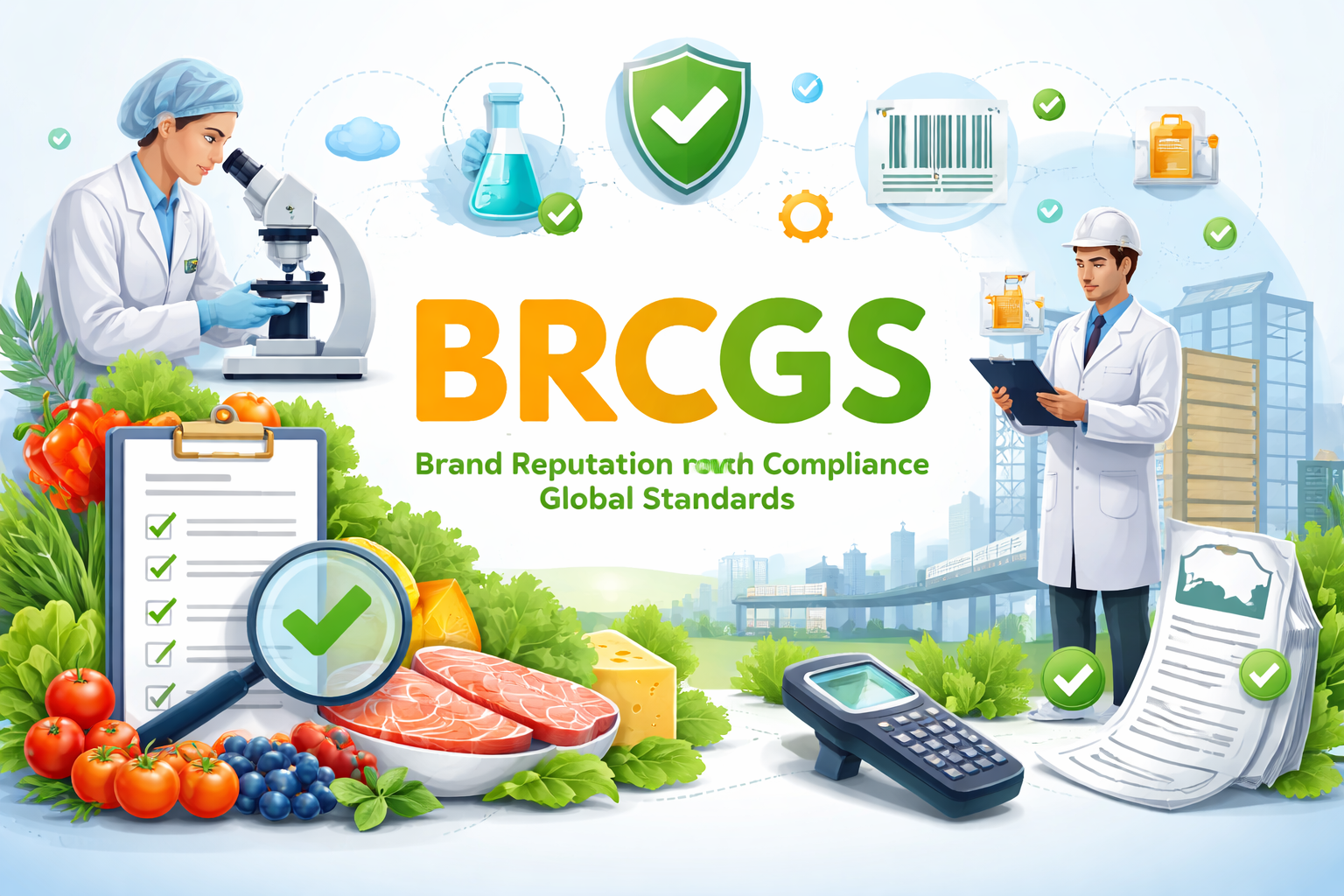
The Ultimate Guide to BRCGS Food Safety: Evolution from Issue 8 to Issue 9
1. Introduction: What is BRCGS?
BRCGS stands for Brand Reputation Compliance Global Standards. Originally founded in 1996 by the British Retail Consortium (BRC), it was created to help retailers and brand owners harmonize food safety standards across the supply chain.
Today, it is the most widely used GFSI (Global Food Safety Initiative) benchmarked scheme globally. For a food technologist or quality professional, a BRCGS certification isn't just a certificate; it is a "global passport" that proves a facility operates at the highest level of safety, legality, and quality.
BRCGS stands for Brand Reputation through Compliance Global Standards, one of the most widely accepted global certification schemes for food safety, quality, and operational compliance. It originated from the British Retail Consortium in 1996 to standardize supplier requirements for UK retailers, but today it has evolved into a global benchmark used in over 130 countries.
BRCGS is recognized by the Global Food Safety Initiative (GFSI), which means it meets international benchmarking requirements and is accepted by major global retailers and brand owners.
1.1 Purpose and Importance of BRCGS
BRCGS was developed to ensure that food manufacturers:
- Produce safe, legal, and high-quality products
- Follow standardized processes
- Maintain traceability and transparency
- Implement risk-based food safety systems
Today, BRCGS is not just a certification—it is a comprehensive food safety management framework.
1.2. Scope of BRCGS Standards
BRCGS has multiple standards, including:
1.2.1 Food Safety Standard (Most Popular)
- For food manufacturers
- Covers HACCP, GMP, quality systems
1.2.2 Packaging Materials
- For manufacturers of food packaging
1.2.3 Storage & Distribution
- For logistics and warehousing
1.24 Consumer Products
- For non-food products
1.2.5 Agents & Brokers
- For traders and intermediaries
The Core Philosophy
Unlike some standards that focus purely on "management systems," BRCGS is highly prescriptive. It tells you exactly what the site standards should be, how the factory should be laid out, and what specific hygiene practices must be followed.
2. The 9 Core Pillars of BRCGS Food Safety
To understand BRCGS, you must understand its structure. The standard is divided into 9 sections:
- Senior Management Commitment: The "tone at the top." Without leadership involvement, the system fails.
- The Food Safety Plan (HACCP): A rigorous analysis of hazards based on Codex Alimentarius principles.
- Food Safety and Quality Management System: The documentation, internal audits, and supplier approval processes.
- Site Standards: The physical "bricks and mortar" requirements—building maintenance, pest control, and cleaning.
- Product Control: Managing allergens, testing, and product claims (e.g., Organic, Non-GMO).
- Process Control: The day-to-day monitoring of weights, volumes, and temperature.
- Personnel: Training, protective clothing, and personal hygiene.
- High-Risk, High-Care, and Ambient High-Care Production Risk Zones: Specific rules for facilities handling sensitive products like ready-to-eat meals.
- Requirements for Traded Products: A voluntary section for sites that buy and sell food products but do not manufacture them.
3. Critical Comparison: BRCGS Issue 8 vs. Issue 9
The transition from Issue 8 (published in 2018) to Issue 9 (published in August 2022) represents a major shift toward "Active Food Safety Culture" and "Validation."
Key Differences at a Glance
| Feature | Issue 8 (Previous) | Issue 9 (Current) |
|---|---|---|
| Food Safety Culture | Introduced as a requirement. | Requires a documented action plan with measurable objectives and behavioral changes. |
| Audit Protocol | Announced or Unannounced options. | Introduces the Blended Audit (Remote Document Review + On-site Inspection). |
| HACCP & Validation | Focused on verification of existing plans. | Heavy emphasis on Validation (proving a process works before it starts). |
| Training | Focused on staff with direct impact on safety. | All staff (including contractors and temps) must be trained on food safety. |
| Equipment | General hygiene requirements. | New requirements for Equipment Design and "Static vs. Mobile" equipment. |
Deep Dive: The Top 5 Changes in Issue 9
1. The "Blended" Audit Protocol
Issue 9 formalized the use of technology. A site can now opt for a two-part audit: a remote assessment of records followed by a focused on-site inspection of the factory floor. However, at least one mandatory fully unannounced audit must occur every three years.
2. Food Safety & Quality Culture (Clause 1.1.2)
While Issue 8 asked sites to "have a culture," Issue 9 asks them to prove it. You must now have:
Clear activities involving all sections of the site.
A plan for how to improve behaviors.
Measurements to see if your culture is actually getting better (e.g., lower internal non-conformities).
3. Equipment Commissioning
A major addition to Section 4 is the requirement for Hygienic Design. When buying new equipment, the site must now have a purchase specification that ensures the machinery is easy to clean and won't harbor bacteria.
4. Root Cause Analysis (RCA)
Issue 9 demands a deeper level of RCA. If a problem occurs, it’s no longer enough to "fix the error." You must prove you have identified the underlying system failure to prevent it from ever happening again.
5. Animal Primary Conversion
For industries like slaughterhouses or fisheries, Issue 9 introduced specific requirements (Section 5.9) to ensure that the initial processing of animals meets strict safety and traceability benchmarks.
4. Why This Matters for Recruitment & Quality Roles
If you are hiring a Quality Executive or Production Manager (especially for specialized industries like potato flakes), they must understand the nuances of Issue 9.
Production Executives now need to be more involved in "Culture" than ever before. They aren't just hitting targets; they are managing the behavior of the staff.
Quality Executives must be experts in Validation. They need to know how to set up a study to prove that a new piece of equipment or a change in a recipe is safe before the first batch is sold.
5. Final Checklist for BRCGS Issue 9 Readiness
If your site is preparing for an audit, ensure these four areas are airtight:
- Culture Plan: Is it signed by the CEO/Managing Director?
- Training Records: Does every single person on site (even the maintenance contractor) have a training certificate?
- HACCP Validation: Do you have scientific data to back up your Critical Control Points (CCPs)?
- Internal Audits: Are you auditing based on risk, or just following a calendar? Issue 9 prefers risk-based scheduling.
Conclusion
BRCGS is one of the most rigorous and trusted food safety standards globally. With the transition from Issue 8 to Issue 9, the standard has evolved to focus more on:
- Food safety culture
- Risk prevention
- Employee behavior
- Real-time compliance
In simple terms:
Issue 8 = System implementation
Issue 9 = System + Culture + Effectiveness